



One check said we were invisible
We asked ChatGPT for white label SEO providers, the service SV is built on. Our brand wasn’t in the answer. We asked again, sixteen times, and SV appeared in six of the answers.
That gap matters to anyone letting an AI agent change a website. The agent edits pages, someone checks ChatGPT, and the brand shows up or it doesn’t. One check before and one after proves nothing, because the same question gets a different answer each time.
Below are the numbers from our test and the measurement routine that does prove whether an agent’s change worked.
The test: one question, three engines, sixteen asks each
On November 19, 2026, we used SV’s RankLens tool to ask ChatGPT, Perplexity and Claude for the most relevant white label SEO providers. Each engine got the same question 16 times. A fourth engine, Gemini, returned an error and is left out.
RankLens records whether a brand appears in each answer and at what position. Sixteen samples is its largest setting. Each call advanced the run by two answers, so a full run took eight calls.
Answers vary because AI engines generate their words by sampling rather than looking them up. Engines that search the web can also see a different set of pages each time. The result is a distribution, not a fixed position.
The number only settles as samples pile up
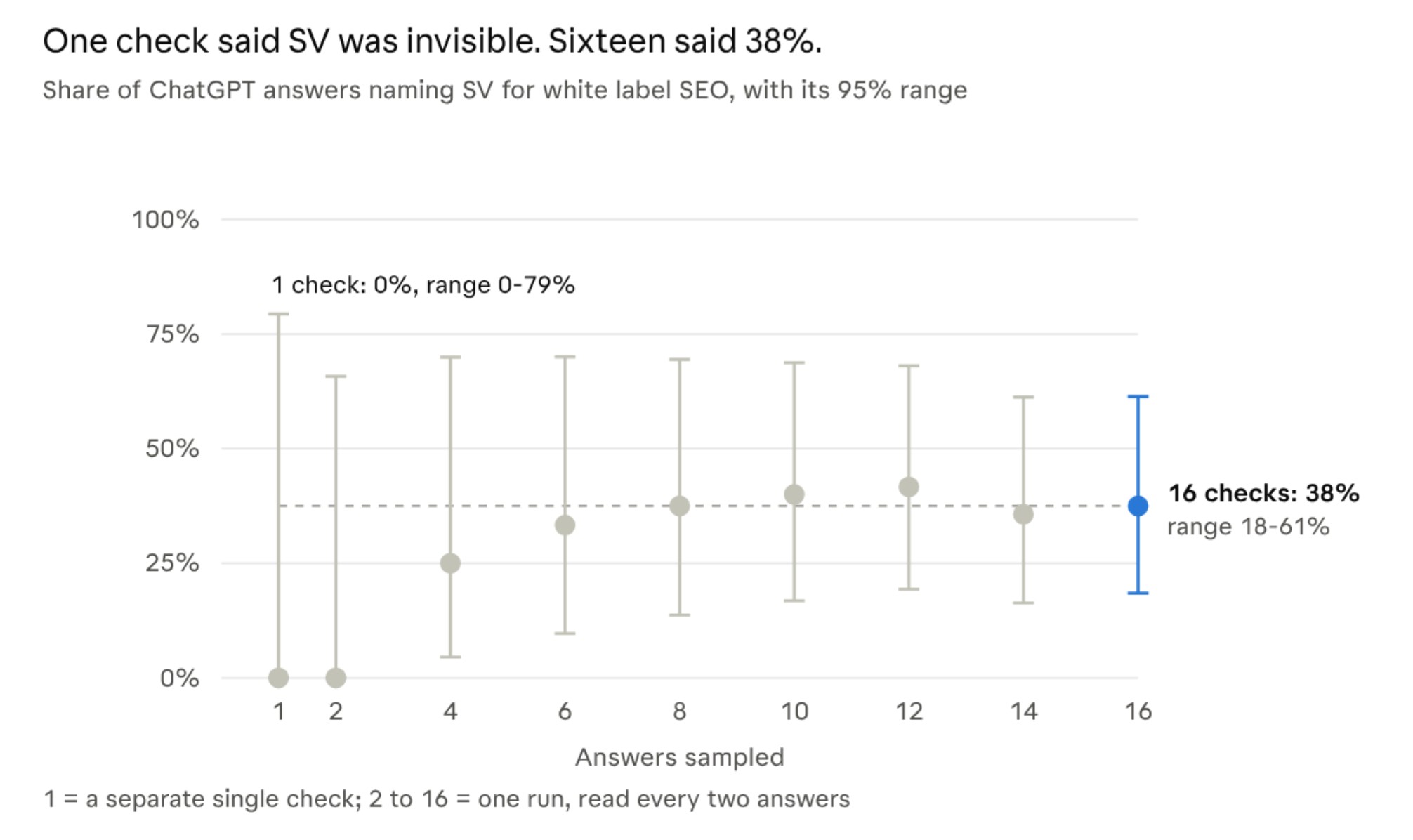

RankLens, ChatGPT (latest), “white label SEO”, November 19, 2026 · ranges are 95% Wilson intervals
The single check sat at zero. The estimate only settled as samples piled up, and even at sixteen its range stayed wide.
What one answer hides
A single ChatGPT answer named about 20 providers. Across 16 answers, it named 87 different brands, counted by domain, and 44 of them appeared only once. Only four providers appeared every time.
Positions moved as much as presence. One provider appeared in 14 answers, anywhere from 8th to 20th. Another was in all 16, anywhere from 5th to 15th.
The engines disagreed with each other too. ChatGPT named SV in 6 of 16 answers, at 10th or 11th. Perplexity and Claude named it in none of their 16. A change that moves one engine may not move another, so each engine you report on needs its own measurement.
How many samples you need
More samples narrow the range, but slowly. For a brand named in about 40% of answers, here is what each sample count can show:
|
Samples per engine |
95% range at about 40% |
Smallest “after” share that proves a gain |
|
8 |
14% to 69% |
100% |
|
16 |
18% to 61% |
81% |
|
32 |
26% to 58% |
69% |
|
64 |
29% to 53% |
61% |
|
128 |
32% to 49% |
53% |
Ranges are 95% Wilson intervals. The last column uses Fisher’s exact test at p < 0.05, with the same sample count before and after.
At 16 samples, a brand named in 6 answers must reach 13 before the gain is proven. Smaller gains need more samples per run, or several runs pooled over weeks.
The routine that proves a change worked
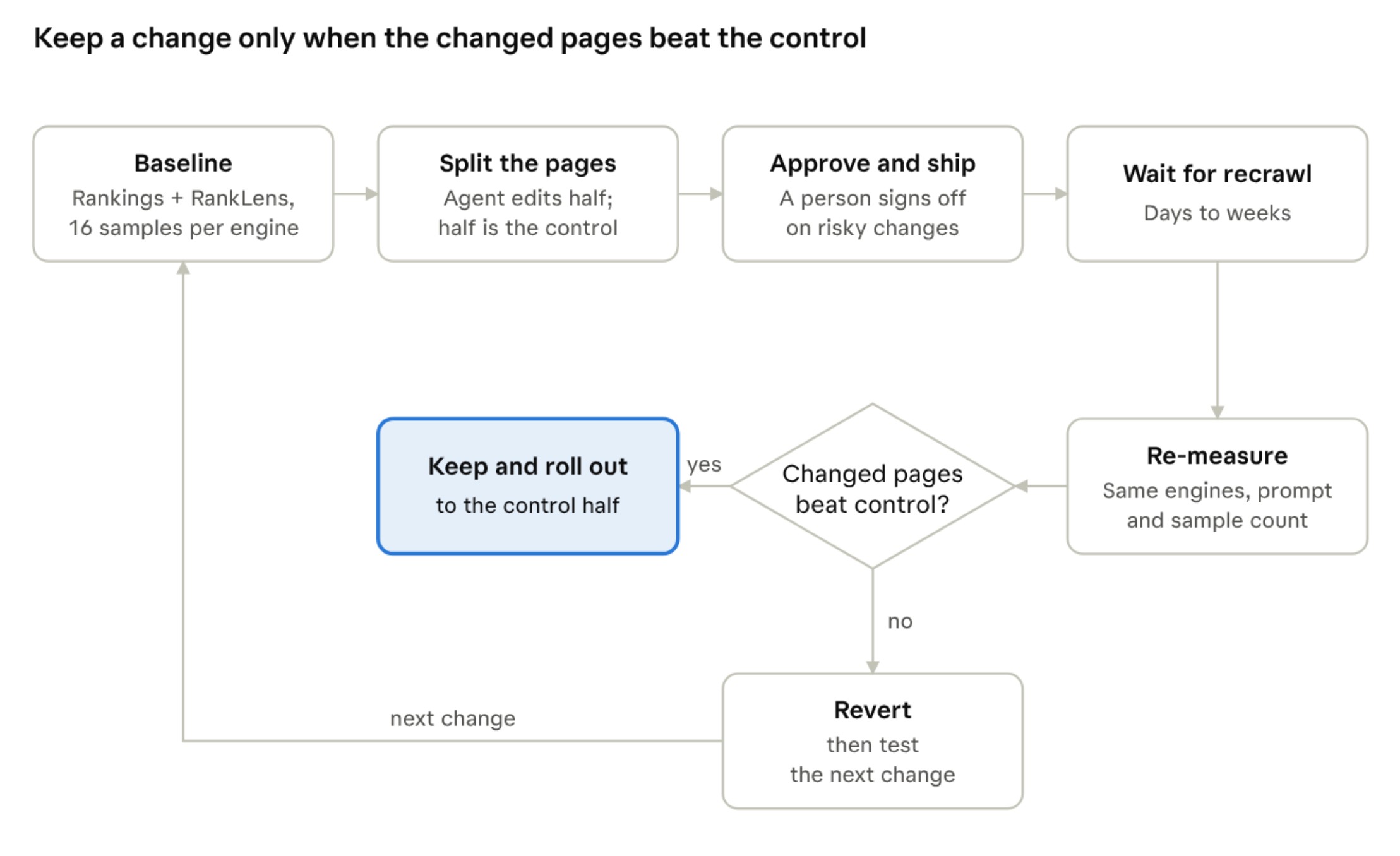

Measurement routine for agent-made changes · 6 steps, 1 decision
The control half is what makes the result believable. If both halves move, something else caused it, such as a Google update. Re-measure with the same engines, prompt and sample count as the baseline, or the numbers aren’t comparable.
The setup: who edits, who measures, who approves
Three parts do the work, and they stay separate:
• The agent edits. Claude Code, Codex or another agent with access to the CMS or the site’s repo makes the changes.
• SV MCP measures and writes. RankLens and GEO Audit take the AI visibility baseline and the re-measure. Core Analysis checks each changed page. Prose drafts copy when a change needs new content.
• A person approves. Changes wait in a queue or a pull request until someone signs off.
Some changes should never go live without that sign-off: title tags on pages already in the top three, canonical tags and robots rules, deleting or merging pages, and any health, legal or financial copy. A mistake there can cost rankings for weeks before anyone notices.
What we’re doing about our own numbers
Our test doubles as a baseline. SV appears in 6 of 16 ChatGPT answers for its core service, and in none of 16 on Perplexity or Claude. Our own changes will be judged against those numbers, with the same sample counts.
SV’s granted US patent 12,093,650 B2 covers an autonomous optimization loop. The routine above is the part of that loop any agency can run today: measure with enough samples, change half the pages, and keep only what the numbers support.
FAQ
Can an AI agent optimize a website safely? Yes, for scoped changes, with a person approving the risky ones. The hard part is proving the change worked, which takes sampled measurement and a control group.
How do I check whether ChatGPT mentions my brand? Ask the same question many times and count the answers that name you. One answer can’t tell you your visibility; sixteen give you a range.
How long should I wait before re-measuring? Until search engines have recrawled the changed pages, which can take days or weeks. Re-measure with the same engines, question and sample count.
Why did Perplexity and Claude never name SV when ChatGPT sometimes did? Each engine draws on different sources and training data. That’s why each engine needs its own baseline.
Measure before your agent changes anything
Connect SV MCP at https://mcp.seovendor.co and run RankLens on your main entity with 16 samples per engine. That’s your baseline. The SV MCP docs cover setup for Claude, Cursor, Codex and other hosts.