


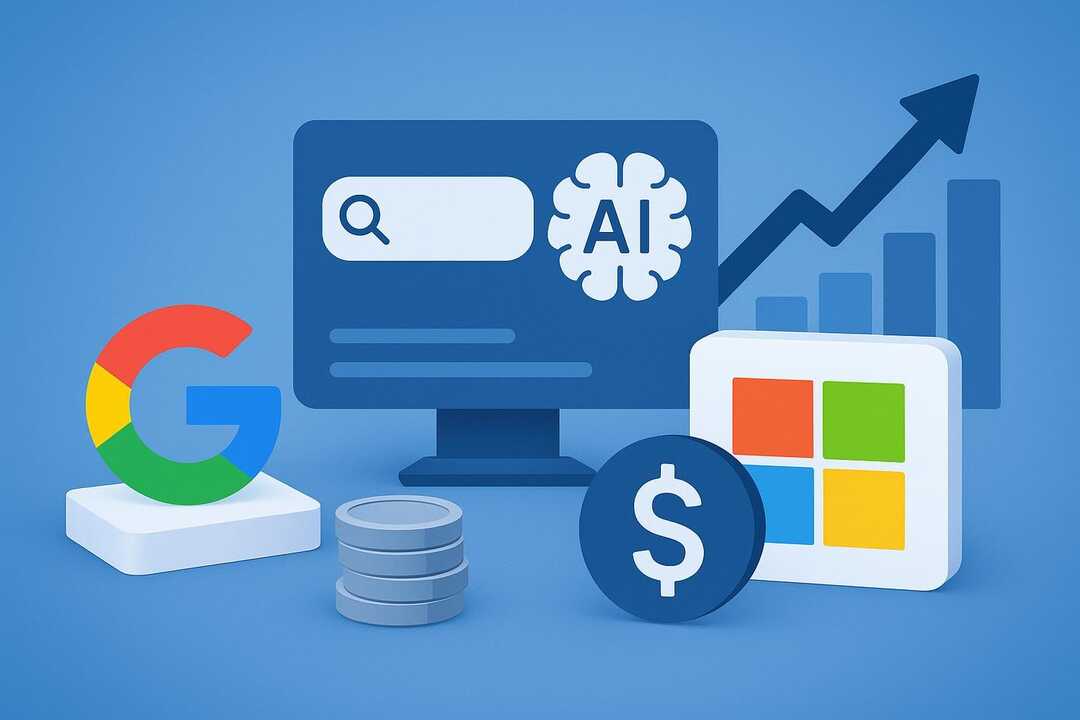
AI search now drives more clicks, more answers, and more ad dollars, so your agency plans will need new rules. That cash has gone up. Google links AI answers to cash, while Microsoft puts in money for growth.
As these platforms change paths, you will need agency work that blends AI search SEO with traffic guard and pricing. In the end, you will see paid, organic, and AI plans work best as one. First, 2026 AI search revenue surges.
AI Search Revenue Surge in 2026
There’s your revenue map.
- Market scale: Analysts put it at $107.2 billion, as Google and Microsoft posted strong top line growth entering 2026. Google reported $402.836 billion for 2025, up 15%, while Microsoft reached $82.9 billion, and it rose 18%.
- Intent growth: Google Search revenue rose 19% to $60.4 billion for the quarter as query volume hit records. When you ask those real, personal questions, you give your agency better signals, and you help sharpen copy, landing pages, and bid choices.
- Reach expansion: Microsoft said Bing reached more than 1 billion monthly active users for the first time. Google also said its AI models had passed 500 million downloads, and you can see their reach keep growing.
- Monetization pattern: Microsoft search and news advertising rose 12%, or 9% in constant currency, showing steady buyer intent. That is why AI search revenue will jump in 2026, as you and other agencies follow live demand signals.
Google’s AI Integration Boosts Earnings
Search ads still fund the business, and you can see AI lift more. As Reuters has noted, you can tie strong GenAI use to more clicks, higher margins, and faster product demand.
- Ad quality gains: AI helps match the right query with the right ad, so you get more sales. That matters because search ads still drive earnings, and better matches can lift pricing.
- Cloud demand: The cloud side grows too, because AI tools make you spend more per customer. Google Cloud has seen demand rise as teams test models, and they often buy more compute.
- User retention: There’s also a stickier path, since AI answers keep you on Google’s surfaces longer. If you don’t leave early, your extra sessions can feed ads and data.
- Investor proof: Reuters reported another platform’s GenAI product revenue jumped nearly 800% year over year in Q1, which sets the bar. It shows why markets back AI that makes money now.
Microsoft’s AI Investments and Growth
Marketers now need hard proof on AI growth. For your 2026 plan, Microsoft’s spend and search gains give you the clearest revenue clues.
- Capital spending scale: Reuters reported Microsoft planned about $80 billion for AI data centers in fiscal 2025. That spend shows you there’s room, and it backs more AI answers, ads, and partner demand.
- Cloud demand signal: In its April 2024 earnings, Microsoft said Azure grew 31%, with AI adding seven points. For you, that is the clearest proof that business AI need had become paid demand.
- Search monetization path: Microsoft told investors search and news ad revenue, excluding TAC, rose 12% in one reported quarter. That matters because AI answer demand can turn into billable media work, landing pages, and feed updates.
- Agency planning takeaway: If buyers pause after weak clicks, you still track assisted leads, branded lift, and your lead quality. The Financial Times noted AI costs stay high, so you must show value fast.
Agencies’ Role in AI Search Optimization
The cash flowing into Google and Microsoft AI search raises the bar for agency work. You get more value from trusted cites, clear tracking, and sales proof than from rank reports alone.
- Entity building: Ignite SEO says AI systems cite clear entities more often than pages built around lone keywords. It also fits Adam Collins’s view that structured data helps machines read your skill.
- Search everywhere reach: SEO Sherpa found your reach must go past Google into AI find across social and visual platforms. Jenny Abouobaia says they answer from many places, so your brand has to move with them.
- Review language signals: Newman found reviews with place names like downtown Seattle give AI engines more strong local context. That helps you guide review asks that match how people say place based questions.
- Measurement and reporting: SeoProfy made AI reach tracking core because basic stats miss visits, and your clients need more clear proof. There are mornings when you check stats before coffee and think the AI work failed.
- Revenue quality: For subscriptions, Copilot traffic converted 17 times better than direct traffic and 15 times better than search traffic. The lesson is clear: you should tie AI search work to sales, leads, and margin.
Adapting Strategies for AI Search Dominance
Brands now win by showing up in AI answers and cited summaries across guided journeys, as Adweek has noted. It matters now.
- Measure influence: Track brand lift, assisted conversions, and journey influence instead of clicks alone. There’s less clicking as AI answers more searches on the page, so attribution ties link views to user actions.
- Build for citations: Keep SEO strong, then add Q and A blocks, lists, tables, and schema. This setup helps AI read your pages fast, cite them more, and lift share of voice.
- Expand presence: Use broad match, smart bidding, and impression based remarketing so people keep seeing you across more touchpoints. You can see AI assisted journeys lift purchases 53% within 30 minutes, while wider placements have delivered 3x ROAS.
AI Search’s Impact on Website Traffic
Now traffic maps look very different. As you tie those earlier tactics to sales, Google and Microsoft answers will cut visits while raising the value of each one.
- For you, the Answer Economy means fewer but warmer visits. Your click gap grows.
- Next, Google AI Overviews now appear on over 18% of commercial queries. It often pushes blue links lower.
- Then Ben Salomon says trust will decide who gets cited and fewer visits can still bring more ready buyers to your site. You see less browsing.
- Elsewhere, Perplexity handles over 780 million queries monthly and its cited results fit the chain of thought style you trust. Those visitors usually know their needs and why they clicked.
- Last, chat based discovery keeps growing. ChatGPT Search reaches over 700 million weekly users and Microsoft Copilot can answer B2B research before your site visit starts.
Pricing Models for AI Search Services
Fair pricing starts with risk. It should match the work, the stakes, and your review load. There’s no shortcut. The base fee often covers audits, prompts, specs, and reports. Then usage fees can apply
These track query volume, page depth, and monthly cite checks. Because 54.2% of pros report weak output quality, we price human review as a core line item. Reboot Online found branded web mentions link at 0.664, so retainers rise when you need outreach, proof, and checks.
That protects your spend and their trust. If you want more steady costs, we suggest a monthly retainer plus audit blocks, since 32% cite weak context and nuance.
Combining Paid, Organic, and AI Search
Across AI search, paid reach, organic trust, and machine-ready pages now drive one revenue plan for you. You win with shared data.
- Unified structure: We build clear pages with schema so AI systems read and recommend your offers.
- Paid support: Gartner forecast a 25% drop in traditional search by 2026, so paid coverage guards demand.
- Content architecture: The clean page layout helps AI read, while your organic pages answer intent before paid clicks fade.
- New metrics: Reuters reported AI answers can cut publisher clicks, so you track impressions, cites, and placement.
- Revenue mapping: It ties paid wins, organic cites, and AI visibility signals to the goals you own.
Preparing Brands for AI Search Future
Soon, your brand must get ready. As Google and Microsoft push AI answers deeper into search, agency revenue plans will back brands when you audit reach early. You can start with the prompts your buyers already use.
Run each prompt several times because the source text notes less than a 1% chance of the same brand list. Then track AI referrals. The source text says these visits grew 527% from January to May 2025, so you will need to track your budget moves.
In addition, BrightEdge found queries with eight words trigger AI summaries more often. So it’s smart to line up facts online. Measure Protocol says 1 in 5 chats have commercial intent. There, 40% already use AI monthly.
AI search revenue is growing up fast. You will win more when you treat ads and answers as one system. However, old search playbooks will fade. As Google and Microsoft add more answer led results, you will need tight metrics, pricing, and content plans.
As a result, revenue will favor clear intent. You have to map each query to value. That work starts now. If you map each result type to profit, you will keep margin while AI answers take more clicks from pages.
In turn, clients will fund agencies that prove helped revenue with clean reports. We see the best path as simple: test faster, price smarter, and show how each search asset drives revenue.