


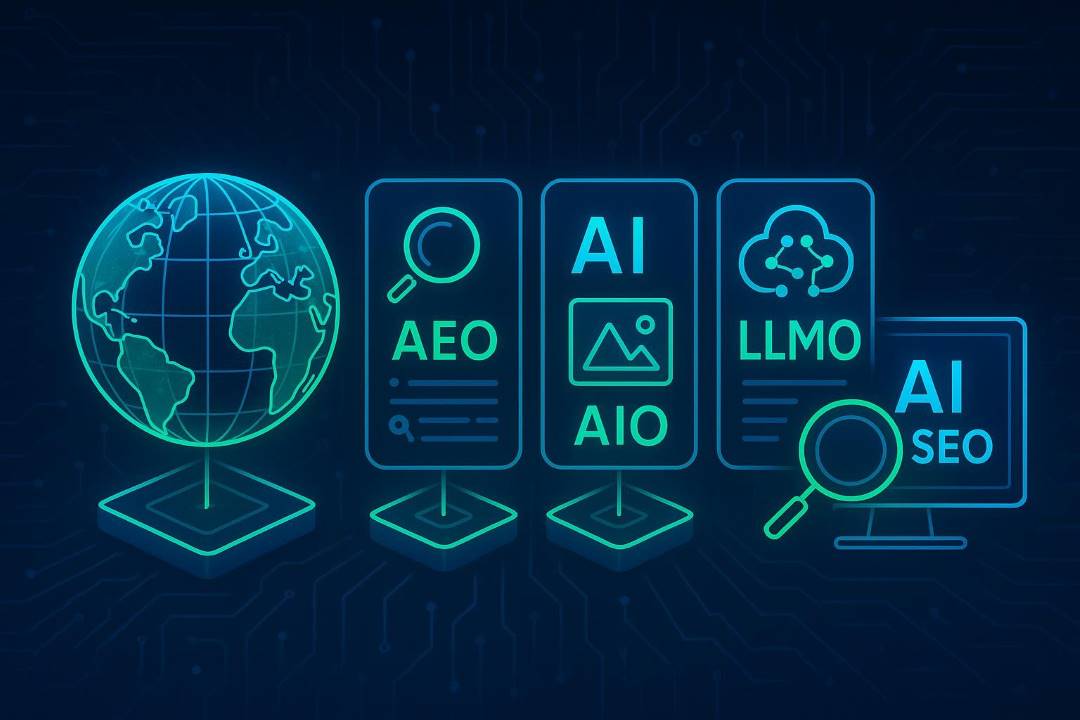
Search engines now use AI to understand queries and deliver results. This shift creates new ways to rank pages beyond traditional SEO. However, naming conventions have gotten a bit out of control.
We will explore the most popular names for creating AI Brand Visibility (GEO, AEO, AIO, LLMO). First, we developed a list of all the acronyms we could find, and what aspects of AI optimization they largely cover.
-
GEO (Generative Engine Optimization) – visibility in generative AI results and AI assistants (ChatGPT, Gemini, Perplexity, AI Overviews, etc.).
-
AEO (Answer Engine Optimization) – appearing as the answer (or cited source) in AI/answer engines and AI Overviews.
-
LLMO (LLM Optimization) – shaping what large language models say and how they cite your brand in AI-generated responses.
-
AISEO (Artificial Intelligence Search Engine Optimization / AI SEO) – using AI to power SEO and to win visibility in AI-driven search experiences (AI Overviews, AI modes, chatbots) as well as classic SERPs.
-
AISO (AI Search Optimization / Artificial Intelligence Search Optimization) – making entities and content discoverable, retrievable, and citable by AI search engines and assistants (LLMs as “search layer,” not just Google).
-
AIEO (AI Engine Optimization / Artificial Intelligence Engine Optimization) – optimizing websites and content specifically for AI engines (ChatGPT, Claude, Gemini, Perplexity) so they can easily understand, reference, and surface your brand.
-
ASO (Answer Search Optimization) – optimizing to appear in “answer-style” search and AI results (answer cards, AI answers), rather than just ranked link lists; note: also historically used for App Store Optimization, so context is important.
-
AIO (Artificial Intelligence Optimization) – broader umbrella term for optimizing content, workflows, and systems around AI, sometimes used as a catch-all that includes AI search and GEO-style work.
-
SXO (Search Experience Optimization) – optimizing the entire search experience (SERPs + AI surfaces + on-site UX) so users not only find you but have a smooth path from AI/organic discovery to conversion.
-
VEO (Voice Engine Optimization) – optimizing for voice assistants and voice search (Alexa, Siri, Google Assistant), so your brand is the one read aloud in spoken answers.
-
LLMAO (Large Language Model Answer Optimization) – explicitly targeting inclusion in LLM answers (not just model memory), i.e., getting cited and recommended by ChatGPT/Gemini/Claude in response to user questions.
Below are the insights we gathered from our research on a few of the most popular names.
Generative search optimization (GEO)
Generative search optimization shapes content for AI models that create new answers. It focuses on how systems like AI Overviews gather and reformat information from sources.
- Query Reformulation: The AI rewrites a user’s question to find better source matches. Your content must align with these refined queries to be selected.
- Source Summarization: Each relevant source gets condensed into a brief summary. Clear, scannable content is more likely to be accurately summarized here.
- Response Generation: The final answer is built from the compiled summaries. Providing complete, authoritative information increases its use in the generated output.
Answer engine optimization (AEO)
Generative search optimization focuses on creating content for AI systems. Answer engine optimization ensures your brand appears in their single, synthesized responses. This shift is critical now. AI Overviews appear in 16% of all U.S. desktop Google searches. Over 400 million people use ChatGPT weekly for information discovery. They’re turning to these tools first.
- It requires a fundamental shift in measurement. Success isn’t about clicks, but citations. Your goal is to be the trusted source an AI engine summarizes. We track visibility and share of voice within AI responses, as this traffic often converts at a higher rate than traditional search.
- Your content must be built for machine comprehension. Clear, direct answers in a conversational format are key. This means using structured data, entity-first organization, and snippet-style formatting. AI crawlers need to easily extract and synthesize your information.
- Brand authority expands beyond your website. Your presence on review platforms, social channels, and in industry citations all feeds the AI’s perception. A cohesive reputation across the web makes you a more likely answer source. This builds the topical authority AI systems trust. Optimizing for answers is the natural next step in a world where AI interprets intent.
AI optimization (AIO)
AI Optimization (AIO) is the comprehensive practice of ensuring your content is found and trusted by all AI-driven systems. It expands your focus beyond traditional search algorithms to include any AI that retrieves information. Sometimes AIO also refers to AI Overviews in Google.
- High-Quality, Authoritative Content: AI algorithms heavily prioritize trustworthy and expert sources for their responses. Your content must demonstrate clear expertise and factual accuracy to be selected.
- Structured Data and Metadata: Proper schema markup provides essential context that helps AI systems correctly interpret your page’s information. This structured foundation is critical for visibility.
- Optimize for Conversational Queries: People ask questions using natural, spoken language when interacting with AI assistants. Your content should directly answer these long-tail, conversational phrases.
- Enhance Domain Authority and Trust Signals: Strong backlinks and positive brand mentions remain powerful signals that AI uses to gauge your site’s credibility and reliability.
Large language model optimization (LLMO)
Large language model optimization focuses on how content is structured for AI comprehension. Its goal is to influence the responses these models generate for user queries.
- Principle: Write for AI Understanding Craft content that clearly defines entities and their relationships. This helps language models accurately retrieve and present your information as a source.
- Tactic: Use Clear, Definitive Language Avoid ambiguous phrasing and prioritize factual, declarative statements within your text. Models are more likely to cite sources that present information with authority and clarity.
- Strategy: Structure for Entity Recognition Organize your content around core topics and their supporting attributes. This semantic structure aligns with how LLMs parse and connect information across the web.
AI SEO
We pioneered AI SEO years before public LLMs, using CORE AI to optimize rankings. Today, AI SEO also means owning what AI engines say about your brand. We call this AI Brand Visibility, and it maps to what others call GEO, AEO, LLMO.
Thus, AI SEO is the use of artificial intelligence to improve how your brand is discovered and recommended, both in traditional search engines and in AI-powered engines like ChatGPT, Google AI Overviews, and Perplexity.
Below are some tips on how to focus on becoming a trusted source for AI systems.
1. Improving Content Authority and Trustworthiness
Search engines now prioritize content that demonstrates real expertise and a trustworthy digital footprint. This evolution makes building clear authority non-negotiable for sustainable visibility.
- Anchor Content with Verifiable Sources: Reference established publications and data in a centralized library. This creates a regulator-ready artifact that travels with your content across all search surfaces.
- Build a Unified Semantic Lexicon: Maintain consistent terminology and concept relationships across all languages and content formats. This preserves your core message as AI interfaces adapt and personalize information for users.
- Orchestrate Cross-Surface Governance: Manage your brand’s presence proactively across search engine results pages, AI copilots, and knowledge panels. Translating complex signals into coherent narratives ensures trust travels with every user interaction.
- Implement Auditable Telemetry Baselines: Establish clear, measurable benchmarks for content performance and user engagement. Health Telemetry provides the data needed to preserve topic depth and authority as algorithms evolve.
2. Aligning Content with AI Search Behaviors
To succeed now, you must align your content with how AI systems find and use information.
- Optimize for Exploratory Queries: AI searches are often for clarification or task completion, not just purchases. A Walmart study found 48% of shoppers see AI tools improving the retail experience.
- Prioritize Credible Citations: Citations in AI answers are clickable links that drive referral traffic and build trust. These links often come from a process called Retrieval Augmented Generation, or RAG.
- Structure for Topical Authority: AI systems reward content that thoroughly covers a subject cluster. This approach helps your brand become a cited source within AI-generated narratives.
3. Monitoring AI Performance and Adjusting Strategies
It’s crucial to track how these systems present your information. You must adapt your approach based on the data you collect.
- Track Your AI Citation Share: Monitor how often AI tools reference your content versus competitors. A platform like RankLens, which is based on a highly reliable entity-conditioned probe method, specializes in this brand visibility and safety intelligence. The data from RankLens can show not only AI Brand Visibility, but also if AI spreads misinformation about your company.
- Analyze the AI Funnel: Discover what AI recommends to prospects before contacting sales. One report found over 30% of inbound leads research with ChatGPT first. Use this actionable intelligence to create clear, comparative content that AI models can easily quote.
- Establish New GEO Key Performance Indicators: Move beyond traditional click-based metrics to track brand mentions in AI answers. A simple dashboard showing your brand appeared in 5% of AI answers about your topic is a vital new key performance indicator. This measures influence in a zero-click environment where visibility alone builds authority.
Staying Updated with AI Search Developments
The pace of change in search is staggering, with new terms emerging all the time. We see this daily with ideas like chunking content and agentic workflows. Staying current means you watch how large language models find their info.
These models heavily favor places like Wikipedia, Reddit, and YouTube. Your brand needs a presence in those conversational spaces. It’s a digital PR play as much as a technical one. Remember that citations within AI outputs change a lot.
Simply refreshing a page date without real updates doesn’t work. You must make sure your content reflects the most recent info out there.
Mastering these ideas builds a strong SEO plan. Geographic and answer-focused SEO help you answer the quick, local questions people ask. AI-assisted workflows and large language models let you create deep content that search engines now reward.
This approach moves beyond chasing keywords to build real topical authority. At SEO Vendor, our AI tools help you run this growth model with less effort. They give you a clear, white-label ready workflow from research to revenue.
No matter what acronyms we end up with, stay focused with a useful roadmap for steady results.