



The 98% problem
Audits are broken for closing clients. Our test prospect’s homepage scored 41 out of 42 on a technical health check. If your pitch rests on audit findings, that score leaves you nothing to sell.
So we handed the prospect’s URL to an AI agent with SV’s tools connected and let it keep digging. It found money keywords stuck on page two, the wrong pages ranking for them, and ChatGPT naming the business under a different domain.
Then it priced the fix from SV’s fulfillment catalog. The tool calls took about four minutes. Here is the full workflow with the real outputs, so you can run it on your next prospect.
What you need, and the prompt
You need an AI agent that supports MCP and an SV account. We used Claude connected to SV’s hosted MCP server, which adds 15 SEO and GEO tools through one URL.
Setup is one step: add https://mcp.seovendor.co as a connector and sign in to SV. Claude Code, Cursor, Codex and other MCP hosts connect to the same URL (setup docs).
This prompt reproduces the run:
Build an SEO and GEO proposal for [prospect URL], a [service] business in [city].
1. Run a health check and an on-page analysis of the homepage for “[service] repair [city]”.
2. Pull the keywords the site already ranks for. Flag money terms on pages 2-5 and any keyword where the wrong page ranks.
3. List the top-ranking competitors for the main keyword.
4. Check what AI engines associate with the site. Then run RankLens for “[service] company in [city]” on ChatGPT and Perplexity, 8 samples each. Repeat each RankLens call until it reports complete.
5. Search the SV marketplace for matching local SEO and GEO services with prices.
6. Draft a white-label proposal: findings, fixes, monthly plan, one-time items, total.
Our test prospect is a family-owned HVAC contractor in a mid-size Mountain West city, a typical agency client. We removed its name, its city and its competitors’ names. Every number below is as the tools returned it on November 19, 2026.
Steps 1-2: The health check passes, the homepage misses the job
Preliminary Audit scored the homepage 41 of 42. Canonical tags, HTTPS redirects, robots.txt and the sitemap all passed. The only flag was robots.txt blocking /wp-admin/, which is normal for WordPress.
Core Analysis shows what the score can’t. The page loads in 276 ms and carries 1,944 words, yet “repair” appears nowhere in its title, H1 or meta description. The exact phrase “[service] repair [city]” doesn’t appear anywhere on the page.
That’s a finding, but a small one. The proposal needs to show what the site is losing, and that takes ranking data.
Step 3: Page two on the money terms, and the wrong pages ranking
Better Keywords returned 247 keywords the site already ranks for. That list is where the proposal starts.
The most valuable terms sit on pages two and three:
|
Keyword (city removed) |
Position |
Monthly searches |
CPC |
|
hvac [city] |
21 |
4,400 |
$45.18 |
|
air conditioning [city] |
18 |
4,400* |
$45.18 |
|
heating and cooling [city] |
18 |
140 |
$139.06 |
|
hvac companies [city] |
20 |
50 |
$123.19 |
|
furnace repair [city] |
12 |
40 |
$74.07 |
*Both 4,400 figures are one shared volume estimate, so count it once. CPC is what advertisers pay per click on the same searches.
The bigger finding is which pages rank. For four service searches, Google ranks a page that doesn’t sell the service:
• “hvac contractor [city]”: the founder’s origin story, position 68
• “heating repair [city]”: a rebrand announcement, position 28
• “heater repair [city]”: the water-heater page, position 34
• “furnace repair [city]”: the maintenance page at 12, while the repair page sits at 21 for a near-identical search
Top Competitors shows who holds page one for “[service] repair [city]”. A BBB category page, a duct-cleaning company’s AC repair page and a home-services directory fill the top three. The prospect isn’t in the top nine.
Step 4: What AI engines say, and the wrong domain
Perplexity, which searches the web as it answers, named the business in 7 of 8 answers to “HVAC company in [city]”. Its position ranged from 4 to 18 and averaged 8.
ChatGPT’s headline count was zero of eight. The competitor list told a different story. ChatGPT did name the business in 2 of 8 answers, at position 12, but paired it with a domain that isn’t the company’s website. RankLens matches mentions by domain, so it filed those two under a competitor.
An agent that reads only the headline number misses this. The fix isn’t “get into ChatGPT”. It’s entity consistency: one name, one domain and the same details everywhere AI engines read about the business. One cause worth checking: the business rebranded, and AI engines also learn from older pages under the old name.
The competition is concentrated. Four local competitors appeared in all eight ChatGPT answers. Insight Igniter adds the last piece: of the four AI engines that answered, two tied the site to [city] service terms and two only to generic HVAC topics.
Step 5: Price the fix before you pitch it
Marketplace Services searches SV’s fulfillment catalog and returns each service with its price. The agency knows its cost before it quotes, so the margin is set, not guessed.
For this prospect the agent matched four line items:
|
Line item |
What it covers |
SV catalog price |
|
Competitive local SEO (XC-Series Starter) |
1 location, up to 10 keywords, 10 pages optimized at launch, citations, monthly content, AI visibility reporting |
$499/month |
|
GEO entity research |
The brand entity: name, domain, attributes, consistency |
$33 one-time |
|
GEO change implementation, 2 pages |
Entity fixes on the homepage and about page |
$98 one-time ($49 per page) |
|
AI search prompt tracking (optional) |
“HVAC company in [city]” tracked monthly across AI engines |
$5/month per prompt |
That’s $499 a month plus $131 one-time at catalog prices, before the agency’s markup. The four wrong-page fixes fit inside the package’s launch optimization. A lighter local package, X-Series Starter, costs $299 a month without the AI visibility reporting.
The proposal the agent drafted
The agent turned the findings into a one-page proposal in the agency’s voice. The agency checks it, sets its price and sends it under its own brand.
1. Where you stand. Your site is technically healthy, scoring 41 of 42. But your main service terms, worth about 4,400 searches a month, sit on pages two and three.
2. Why. Google ranks the wrong pages for four service searches, including your founder story and a rebrand post. ChatGPT names you under a domain that isn’t your website.
3. First 30 days. Point each service search at its service page. Make your name, domain and details consistent across your site and listings.
4. Ongoing. Competitive local SEO for your money terms: on-page work, citations, monthly content and AI visibility reporting.
5. How we’ll prove it. Monthly positions for the five money terms, plus 8-sample AI checks on ChatGPT and Perplexity for “HVAC company in [city]”.
6. Investment. [Agency price] a month, plus [agency price] one-time.
Item 5 matters most. Single AI answers change from one ask to the next, so the proposal promises sampled numbers, not screenshots.
What it took, and what to watch
The run made 16 successful tool calls and used about four minutes of SV server time. RankLens took half of it, because every sampled AI answer is a live query.
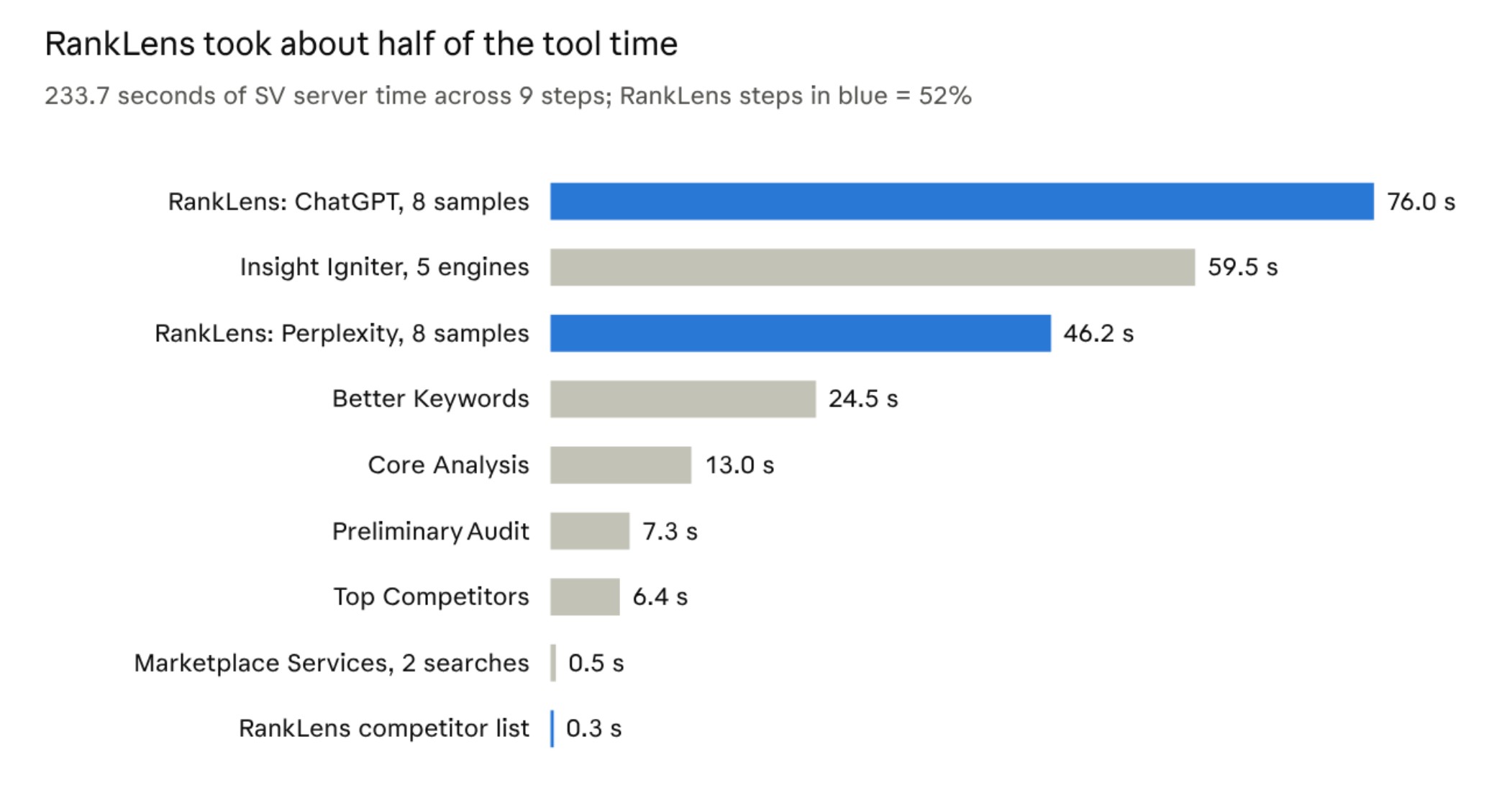

SV API server time per call (duration_ms), summed by step · run of November 19, 2026
Four things trip agents up:
• Rate limits. The SV API accepts one request per second per key. Fire seven calls at once and some come back rate-limited; those failed calls are free, so retry them.
• Multi-sample RankLens runs. Each call advances two samples, so an 8-sample run takes four identical calls. Stop early and you quote a partial number.
• Competitor lists. Read them, not only the headline count. That’s where this brand turned up under the wrong domain.
• Grouped volumes. Two keywords can share one volume estimate. Count it once.
Each successful call spends SV points from your account.
FAQ
Can an AI agent build an SEO proposal on its own? It can gather the evidence, match services and draft the document. A person should check the findings and set the price before it goes out.
Which SV tools does this workflow use? Seven: Preliminary Audit, Core Analysis, Better Keywords, Top Competitors, Insight Igniter, RankLens and Marketplace Services.
How many AI samples should a proposal quote? We used 8 per engine. A single AI answer changes from one ask to the next, so it can’t back a claim to a client.
Does it work with agents other than Claude? Yes. SV MCP works with any MCP host that supports remote servers, including Cursor, Codex and VS Code.
Run it on your next prospect
Add https://mcp.seovendor.co as a connector, sign in with your SV account and paste the prompt above with your prospect’s URL. The SV MCP docs cover setup for each host.