Answer the questions that lead to business.
Find missing service details, comparisons, and decision-making information on the pages you need customers to discover.


SV GEO AUDIT FREE ACCOUNT
Make your business easier to find, trust, and choose in AI search. See where your pages need better answers, where proof is missing, and which improvements deserve your attention first.
Already have an account?
Open GEO Audit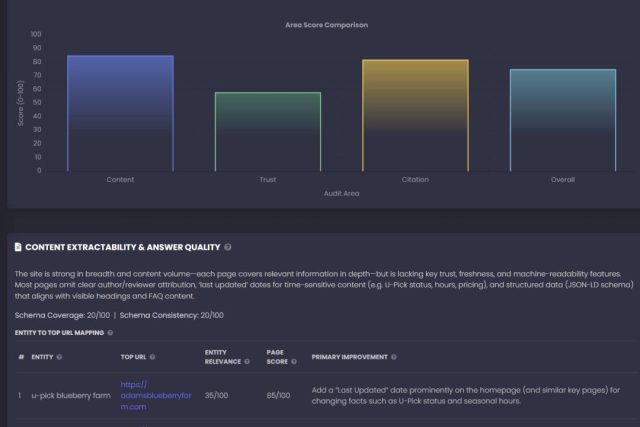
More than a score. Your report connects findings to content, schema, trust, and citation actions.
Example report output. Readiness scores are not traffic, lead, or AI citation results.
Readiness areasContent, trust, citations & overall
Page-level actionsKnow where to make the change
Quick wins to prioritizeA practical place to start
THE NEXT CUSTOMER IS THE POINT
Generative engine optimization (GEO) focuses on making your business easier for AI systems to understand and reference. Start with the questions your customers ask—and the pages that should answer them.
Find missing service details, comparisons, and decision-making information on the pages you need customers to discover.
Spot unclear brand information, weak supporting proof, and inconsistent details before they undermine the story your website tells.
Move from “we should improve our AI visibility” to specific page updates, development tasks, and outreach priorities.
ONE REPORT. CLEAR ACTIONS.
Your free GEO audit brings the findings together: which pages need attention, what to add or change, and how to organize the work. Here is what the report looks like.
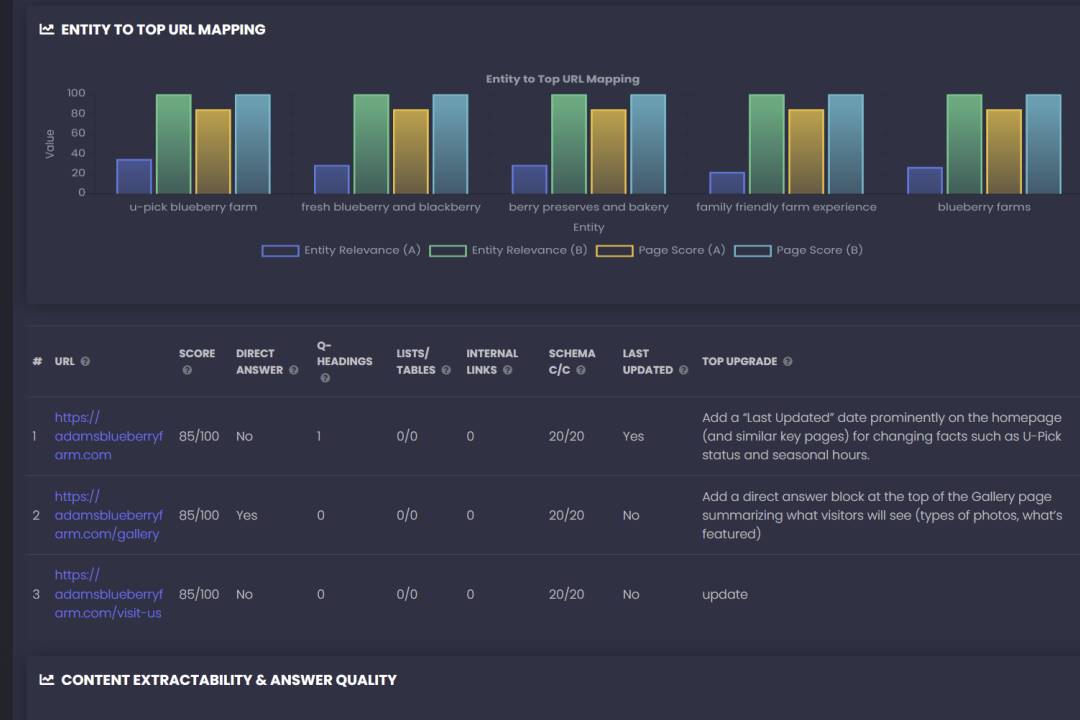
01 / PAGE & INTENT MAPPING
Which page should represent each service, product, or customer need? Entity-to-page mapping helps you focus the work instead of spreading it across the whole site.
Start with the pages that support your most important services and sales conversations.
02 / CONTENT & CITATION OPPORTUNITIES
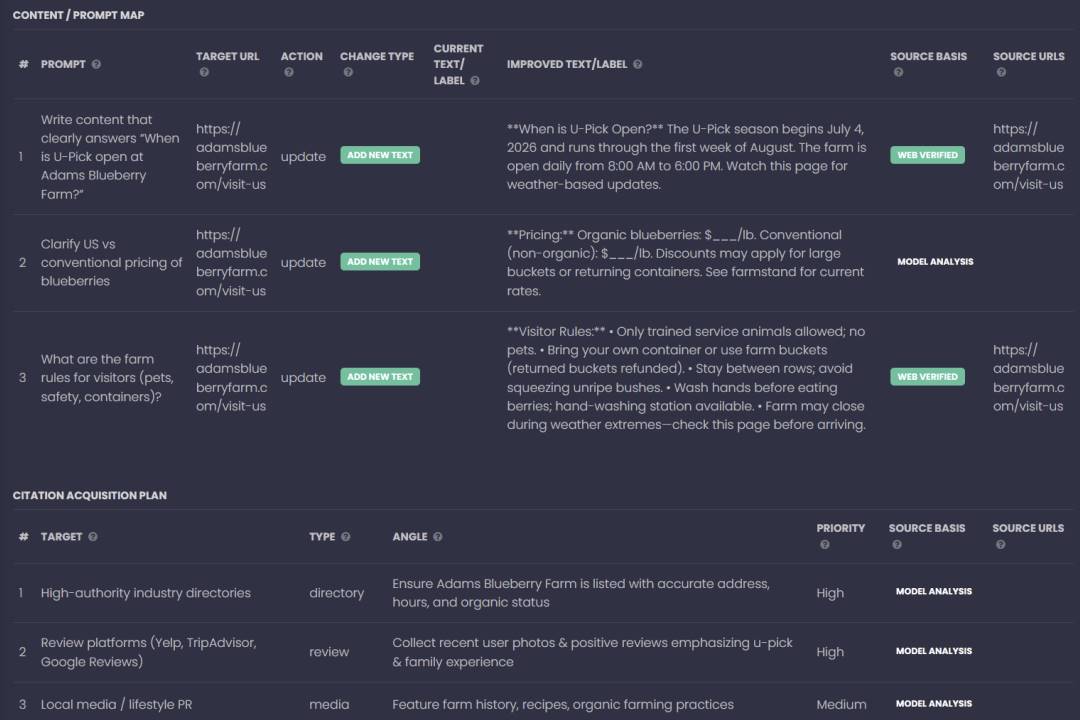
Get a content and prompt map that connects a question to its target page, the recommended change, and the text or section to review.
Use competitor citation patterns and profile consistency checks to prioritize third-party proof.
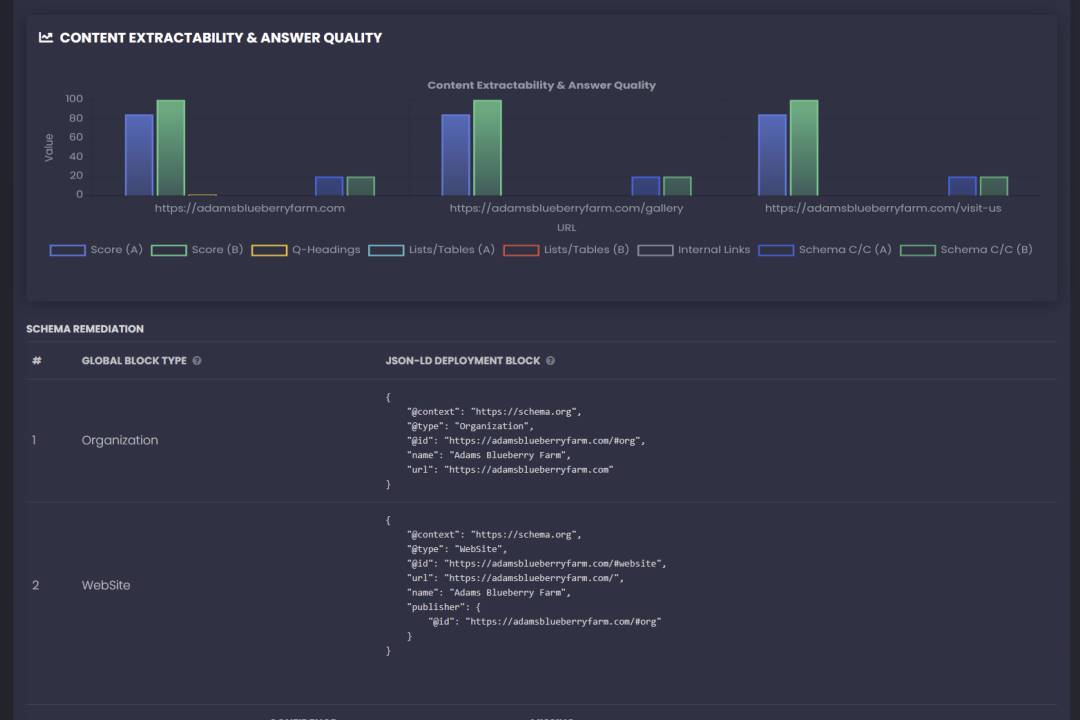
03 / SCHEMA REMEDIATION
Review missing fields and inconsistent structured data. Get Organization and WebSite blocks, relevant template-level JSON-LD, and implementation tickets your developers can validate and deploy.
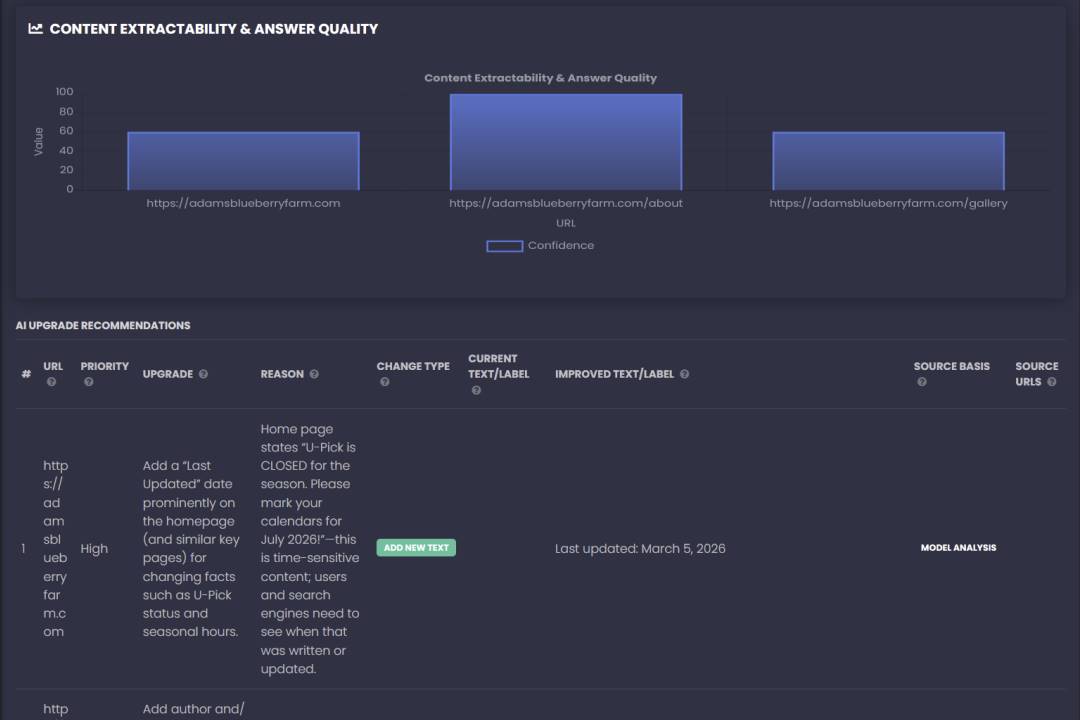
04 / TRUST & BRAND CLARITY
Review identity, credentials, authorship, policies, and proof. Pass, partial, and fail findings translate into specific updates, with priorities and supporting reasons your team can review.
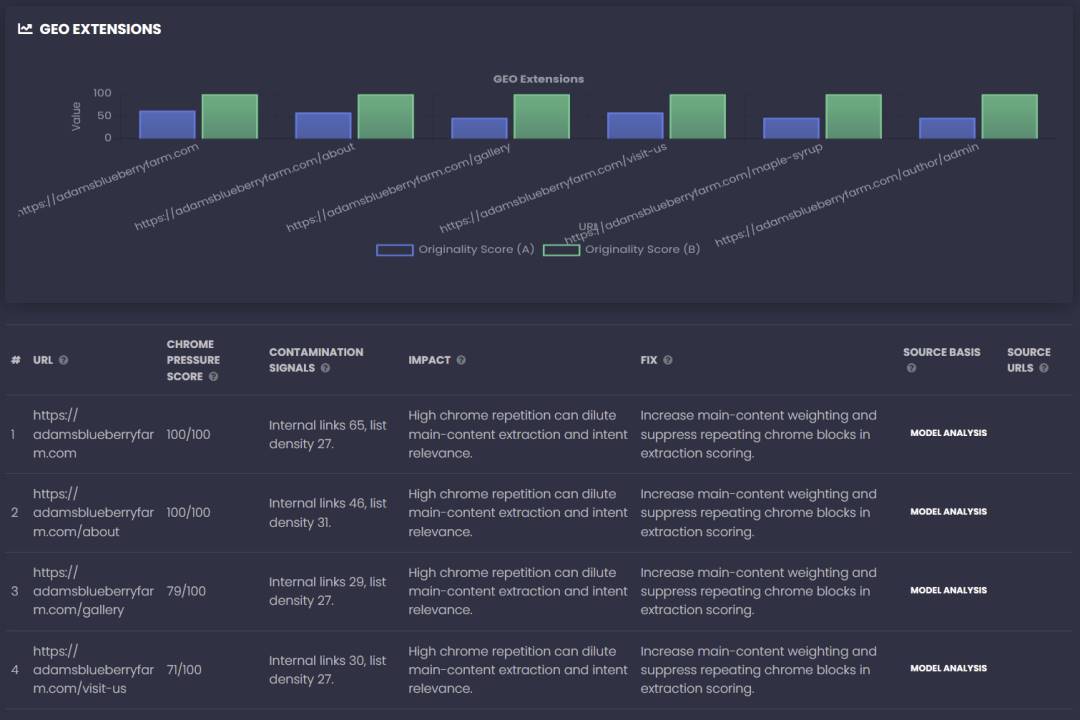
05 / DEEPER GEO CHECKS
Look beyond surface fixes. Review intent gaps, preferred pages, entity relationships, and whether repeated navigation or boilerplate overwhelms the useful content. Plan cite-worthy tables, checklists, and process steps.
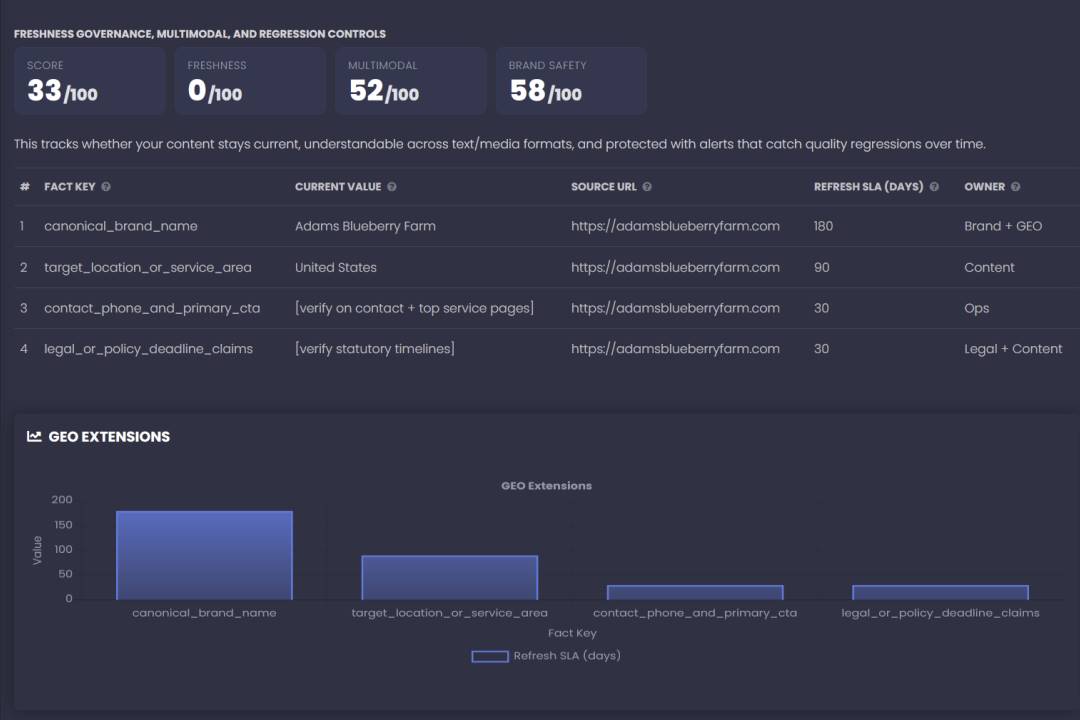
06 / FRESHNESS & GOVERNANCE
Build a facts registry for changing details such as hours, pricing, policies, and contact information. Assign refresh intervals and owners, then use the report’s regression-control guidance to plan checks for new problems.
Replace a general GEO checklist with recommendations tied to your website.
FROM FINDING TO FIX
The audit gives you a starting point, a Top 10 quick-win list, and a phased roadmap. Your team chooses the priorities and approves the changes.
Sign up free, open GEO Audit in the SV platform, and add the website you want to review.
YOUR OUTPUT A site-specific auditUse the action tables to brief content, development, outreach, and other responsible teams. Review suggested text and schema before publishing.
YOUR OUTPUT A practical implementation planRe-run after important updates. Use RankLens for AI visibility benchmarks and your analytics to evaluate visits, enquiries, and sales separately.
YOUR OUTPUT A basis for the next decisionDifferent tools. Different jobs. GEO Audit recommends what to improve. RankLens measures what supported AI engines say and cite. Preliminary Audit checks technical access and crawl reliability.
Explore RankLensFOR AGENCIES & IN-HOUSE TEAMS
Show which page needs work, why it matters, and what your team proposes to do next. Use the audit to turn an AI visibility discussion into a clearer project brief.
Keep each site organized. Add multiple websites and run separate reports for different projects.
Make the handoff useful. Use the HTML-friendly report view for client delivery and turn action tables into internal tickets.
Get help with the findings. Use support when you need help interpreting recommendations or prioritizing the work.
NEED HELP WITH IMPLEMENTATION?
Use your own team, or talk to SV about a managed GEO campaign. The free audit provides recommendations; implementation is a separate next step.
BEFORE YOU START
A generative engine optimization audit reviews how clearly your website answers relevant questions, identifies your business, and supports its claims. SV’s GEO Audit brings content extractability, trust and entity clarity, citation readiness, and overall readiness into one report with recommended next steps.
Yes. Create a free SV account to run GEO Audit reports and access the action tables. Advanced workflows and additional tools may depend on your account plan. The free audit does not include a managed implementation campaign.
The report includes a readiness snapshot, entity-to-page mapping, page-level checks, content and prompt recommendations, schema remediation, trust fixes, citation priorities, and a phased roadmap with re-test guidance. It also covers deeper GEO checks and freshness governance.
A traditional SEO audit concentrates on search performance, crawlability, and technical or on-page issues. GEO Audit adds a focus on answer clarity, brand verification, content structure, and supporting sources that may help AI systems understand and reference your business. The two approaches complement each other.
GEO Audit focuses on what to improve. RankLens is the complementary tool for benchmarking what supported AI engines say and cite. Keep those visibility measurements separate from the audit’s readiness scores.
See RankLensNo. It provides recommendations, suggested content, and schema blocks for review. You, your team, or a separately engaged service team implement the changes. Check facts, source support, and technical compatibility before publishing.
Yes. Add multiple sites and run separate reports so projects stay organized. The HTML-friendly report view supports client delivery, and the action tables help you prepare implementation tickets for your team.
During active optimization, a monthly review provides a regular checkpoint. Once the site is more stable, quarterly reviews may be sufficient. Re-run after significant content, design, or template changes rather than waiting for the next scheduled review.
Not by itself. The score is a diagnostic starting point, not a sales result or a guarantee of AI recommendations. Use the findings to guide improvements, then assess actual AI mentions, referral visits, enquiries, and conversions to understand the business impact.
YOUR WEBSITE. YOUR NEXT MOVE.
One report. Clear priorities. A practical plan to make your business easier to understand, trust, and choose.
Create your account → Add your website → Run your report