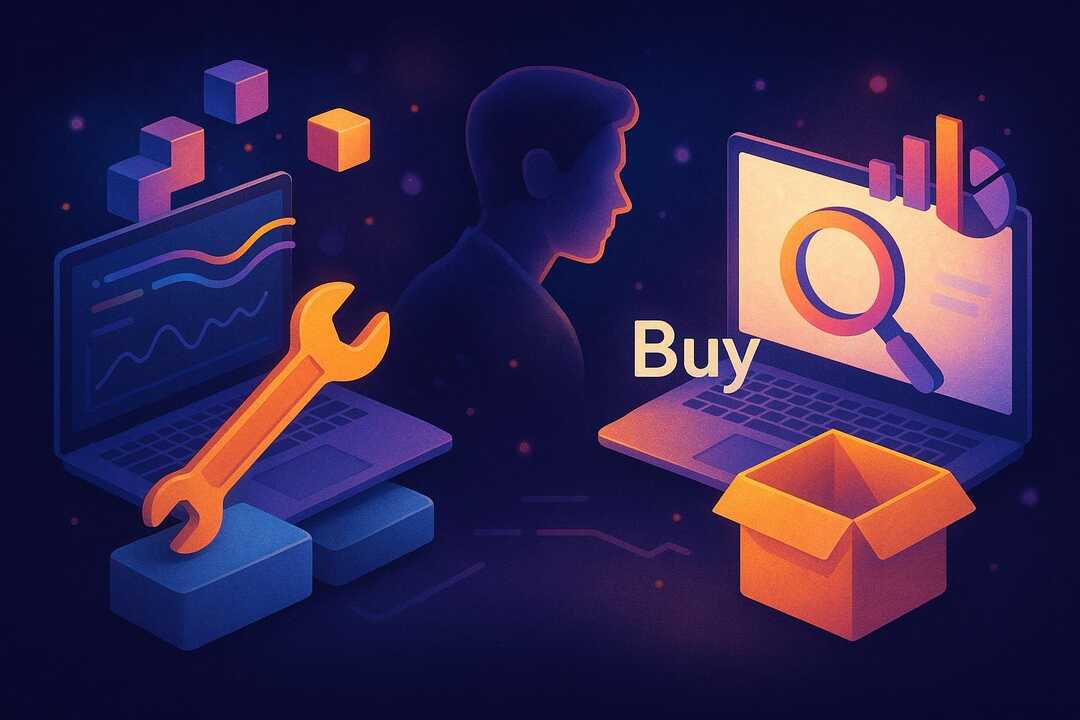
Build versus buy is a tool choice. You will weigh control, cost, speed, and agency fit. Then you compare in house builds with licensed tools across total cost of ownership, custom fit, time to launch, upkeep, and tie ins.
Table of Contents
Scale adds fresh pressure. You also need a checklist for your team skills, your data needs, and your limits. That starts with one plain question: what does the build versus buy SEO tools dilemma mean for your agency?
What Is the Build vs Buy SEO Tools Dilemma?
This table compares four core build versus buy points.
| Agency factor | Build | Buy |
|---|---|---|
| Core idea | You make a tool for your own process. | You pay for a ready tool. |
| Main tradeoff | More control and fit. | Less control, faster use. |
| Team need | Dev time and upkeep. | Training and vendor review. |
| Decision test | Choose it if the workflow is rare. | Choose it if the need is common. |
Comparison Table of Building vs Buying SEO Tools
Recent behavioral studies show 37% of consumers start with AI, so we compare four agency decision points.
| Point | Build | Buy |
|---|---|---|
| Core metric | Track AI Share of Voice and brand citations your way | Use vendor reports; check pipeline ROI, as Forrester urges |
| AEO setup | Custom schema and explicit answers for your entity map | Faster templates; less control |
| Human review | Fits expert workflows; reduces hallucination risk | Needs strong team checks |
| Budget mix | Avoid the 45% software and 9% training trap | Lower build cost; still fund people |
How To Evaluate Total Cost of Ownership for Tools
From that side by side view, use these five steps to price real ownership costs for your build versus buy call.
- List setup time in hours, days, and weeks. The source says bought tools go live in hours, while custom builds take days to weeks.
- Add month six upkeep work. The source warns week one tools rarely match what you still need later.
- Price rebuilt basics like auth and analytics. Those hidden jobs drain budget before your SEO edge shows.
- Score whether the tool sets your agency apart. If it’s back office plumbing, you should buy.
- Count feedback lost during delays. Live tools start learning today, which helps your later build choices.
Checklist of Agency Requirements for Building Tools In-House
Use these five checks first.
- Set your volume floor. Near 1M chats a year is the cutoff.
- Budget your core staff. You can put Year 1 at $120K+ plus $60K to $80K ops.
- Cap your first build scope. You can place a basic MVP at $50,000 to $100,000.
- Check your data rules first. If you have doubt, keep it in house.
- Guard lock in risk. Parallels says 94% of groups worry about it.
- Keep your model layer flexible. OpenRouter reported open weight share near 30% by late 2025.
Limitations When Choosing Build Over Buy SEO Solutions
After that check, weigh four build risks.
- Resource gaps hurt when your team lacks engineering or security skill.
- The real cost grows over time, because when you build, you also plan, do upkeep, teach users, and give ongoing support, as the source notes.
- It invites the “sunk cost fallacy.”
- There’s opportunity cost, and your other bets may wait while you build.
Common Questions Agencies Ask About Tool Acquisition
Here are four questions agencies ask most.
- Will it drive results? Start with revenue, retention, margin, or speed. If you can buy the same tool as your rivals, it’s rarely your edge.
- Can you run it? The top failure is “we picked something we can’t use.” Build only if you have tests, checks, and incident response.
- How fast can you test? Prove tradeoffs in two weeks with one real workflow slice. Prototypes are cheap, but the last 20% is still 80% of the work.
- What should stay custom? Buy the basic core, then build the parts tied to your data, rules, and stack.
How Customization Impacts Long Term SEO Performance
Custom tools help long term SEO because they match what people search for to each client goal. In build versus buy reviews, that edge matters for your niche clients. The source says AI rewards quality, relevance, and user experience above all else.
It also says NLP helps engines read questions, so your pages should answer them in plain words. There’s more lasting value in content hubs than in lots of thin pages. You keep cleaner data because the tool fits your process.
However, if bought software blocks that fit, your SEO gains can level off.
When Buying Offers Faster Time To Market Benefits
Purchased SEO tools get your agency to market faster. You skip long build cycles. Google Search Central says core updates happen a few times a year, so faster access helps you act before clients feel pain.
That speed therefore protects revenue. We have seen teams launch audits in weeks. By contrast, internal builds often stall. If your pipeline is full now, buying lets you serve accounts sooner while you spend time on strategy.
Measuring Scalability and Integration Challenges
Scalability often favors buying, because you avoid custom code for each tool and client need. Agency strain grows fast. Your scorecard weighs tool count, auth, and upkeep. It says 23-30 suggests buy, because your broad access, managed authentication, and upkeep needs can swamp your team over time.
There’s another test. If you need one deep SEO link plus many connections, then hybrid fits, since you build two links and buy the rest.
Most agencies should buy first. For most agencies, buying wins until tool gaps hurt margin, speed, or client fit. In particular, buying can cut your launch time and your support risk when your team needs results in weeks, not quarters, for new clients.
Building can pay off when you have a rare workflow, you have tight data rules, or off the shelf tools make extra work. However, tradeoffs will stay real. Custom tools have upkeep costs that many agency plans miss.
Before you choose, score each option on total cost, time to value, data control, team skill, and client demand. That score will guide you.