

A practical, publication-ready guide to using SEO Vendor’s improved Topical Authority Tool and SEO GPT 2 AI Writing Agent to plan, write, and publish content for Generative Engine Optimization.
Table of Contents
Search is no longer only about ranking a page for a keyword and hoping someone clicks. More users now ask AI systems complete questions, compare options in natural language, and expect fast summaries that feel useful and trustworthy.
That shift changes content strategy. To earn visibility in AI-driven search experiences, content has to do more than mention a topic. It has to answer clearly, organize information well, and present facts in ways that are easy to extract, cite, and summarize.
SEO Vendor’s improved Topical Authority Tool and SEO GPT 2 AI Writing Agent now support that full workflow. One helps you generate better GEO-ready topic ideas. The other helps you turn those ideas into stronger GEO-ready articles. Together, they create a practical system for building content that serves both human readers and generative search engines.
GEO works best when you stop planning around vague keywords and start planning around clear questions, proof, and extractable answers.
Why GEO matters now
Search behavior is changing from short keyword inputs to longer, more conversational prompts. People are increasingly asking AI systems to compare options, explain trade-offs, summarize research, and recommend next steps. That means content has to do more than rank. It has to answer clearly.
That is where Generative Engine Optimization, or GEO, comes in. GEO helps you create content that is easier for AI-driven search experiences to understand, reuse, quote, and cite. It does not replace traditional SEO. It builds on it by making the final article more structured, more evidence-friendly, and easier to extract into smaller answer blocks.
SEO Vendor’s upgraded workflow supports that full process. The improved Topical Authority Tool helps users generate sharper, more analytical GEO topic ideas. Then the improved SEO GPT 2 AI Writing Agent helps turn those ideas into stronger GEO articles through a dedicated GEO pathway built for answer-first structure, extractable sections, and citation readiness.
The big idea: plan for answers, not just rankings
The strongest GEO content strategy starts before the draft. It starts with editorial intent.
In traditional content production, teams often begin with a broad keyword and aim for a readable article. That can still work, but AI-driven search environments reward something more specific: content built around questions, choices, frameworks, risks, proof points, and direct answers.
A useful way to think about it is this: standard SEO often begins with what users type, while GEO often begins with what users really want to know. That difference leads to better topics, better sections, and better finished content.
Step 1: Generate GEO topic ideas in Topical Authority
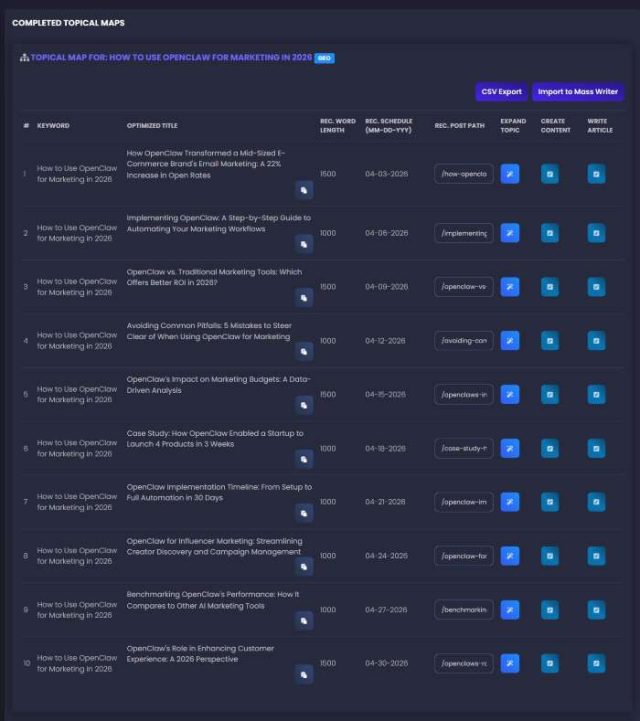
Inside Topical Authority, users can choose between standard SEO Topics and GEO Topics. GEO Topics are built to produce ideas that are more conversational, more analytical, more evidence-oriented, and more aligned with the kinds of questions AI systems summarize well.
The workflow is simple. Open Topical Authority, choose GEO Topics, enter your main topic or keyword, run the generation flow, and review the topic map. From there, you can expand promising ideas, review history, and export the runs you want to keep.
The real difference is not the button. It is the direction of the output. GEO Topics are designed to surface stronger editorial angles such as comparisons, ROI and cost questions, trend and benchmark topics, case-study directions, decision frameworks, implementation guidance, and risk or trade-off content.
What a good GEO seed topic looks like
Broad subjects can work, but GEO performs best when the input already hints at a real user problem, measurable outcome, or decision point.
Weak seed topic: SEO and AI.
Stronger GEO seed topic: How Generative Search Changes Local SEO for Dental Practices.
That stronger seed gives the system more to work with. It implies an audience, a context, a change in the market, and a practical question that deserves a structured answer.
Example topic map: local SEO for dental practices
Imagine a dental marketing team wants to create a GEO-focused content cluster. A GEO run in Topical Authority could lead to article directions such as:
- What Generative Search Means for Local SEO in Healthcare
- GEO vs Traditional SEO for Dental Practice Websites
- Common Questions Patients Ask AI Before Choosing a Dentist
- How to Structure Local Service Pages for AI-Driven Search
- Mistakes Dental Practices Make When Publishing Thin AI Content
- How to Measure GEO Content Impact Across Multiple Locations
These are stronger than generic topic ideas because each one naturally suggests the kind of article structure GEO thrives on: definitions, comparisons, FAQs, steps, evidence, limitations, and implementation guidance.
Step 2: Review the topic map like an editor, not just a marketer
Once the topic map is generated, the next job is not to pick the most clever-sounding title. It is to identify the topic with the clearest answer opportunity.
A strong GEO topic usually checks four boxes. First, it matches a real audience question. Second, it supports proof, examples, or quantified evidence. Third, it lines up with a decision stage such as learning, comparing, evaluating, or choosing. Fourth, it can grow into a content cluster instead of living as a one-off post.
This review step is where beginners get clarity and experts get leverage. Beginners can avoid vague blog ideas. Experienced teams can build a more scalable editorial roadmap.
A simple GEO topic filter
Before you move a topic into article generation, ask:
- Can this article answer a question directly within the first few paragraphs?
- Can it include comparisons, examples, steps, numbers, or evidence?
- Can each major section stand on its own if quoted or summarized by an AI system?
- Can this topic branch into related supporting content later?
If the answer is yes, the topic is usually strong enough to move forward.
Step 3: Expand promising topics before writing
One of the most overlooked advantages of the GEO workflow is topic expansion. If a topic feels promising but still a little broad, expand it before you start drafting.
Expansion helps reveal the article’s best sub-angles. For example, a single GEO topic can quickly break into question-led follow-ups, comparison blocks, checklist sections, how-to steps, or mistakes-to-avoid angles.
That means the writing stage begins with a clearer editorial brief and a better section plan. The result is usually less rewriting, stronger structure, and better final extraction quality.
Step 4: Move the winning topic into SEO GPT 2 and choose the GEO pathway
Once you have a strong topic, switch to SEO GPT 2 and start a new article. Enter the topic clearly, add the normal article inputs, and then set the Pathway to GEO in Advanced Options. (Highly recommended: use Anthropic Claude as the AI engine for GEO.)
This is where strategy turns into execution. The GEO pathway tells the system to shape the piece for AI-friendly reading and citation, not only for standard article flow.
The notes field becomes especially important here. The more clearly you explain the target reader, the angle, the examples to include, the claims that need support, and what to avoid, the more useful the GEO output tends to be.
A model GEO brief
- Topic: How Generative Search Changes Local SEO for Dental Practices
- Audience: dental practice owners, healthcare marketers, agency account managers
- Angle: explain how AI-driven search changes visibility, trust, and local content strategy
- Include: common AI-style patient questions, content structure recommendations, examples of stronger subheads, risks of thin pages, and practical next steps
- Support needed: relevant statistics where available, trade-offs, concrete examples, and clear limitations
- Avoid: generic AI hype, vague claims, and keyword-stuffing language
Why the verify step matters so much
Before generation, SEO GPT 2’s GEO flow lets users review the planned sections. This is one of the most important moments in the entire workflow because GEO works best when each section is clear enough to make sense on its own.
In practice, that means the system may intentionally reshape sections based on intent. Question-driven sections may become FAQ blocks. Comparison sections may become tables. How-to sections may become step lists. Risk and limitation sections may turn into bullets. Definition sections may lead with a direct answer instead of a long warm-up.
That is not a loss of style. It is a gain in usability. These are the content forms AI systems often reuse best because they are easier to extract, summarize, and cite accurately.
What strong subheads look like
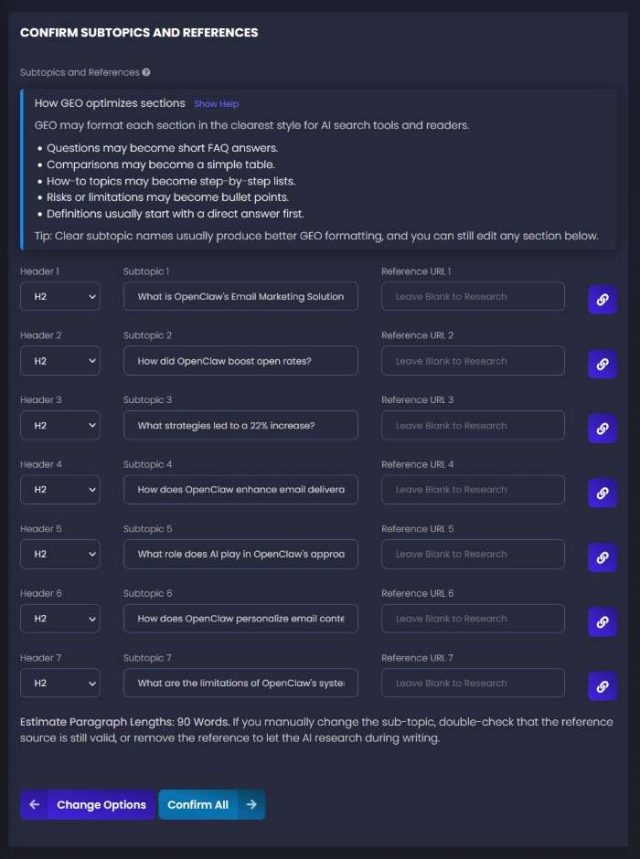
A GEO article usually performs better when the subheads sound like real questions or clear editorial promises.
Strong subheads include examples like: What Generative Search Means for Local SEO, GEO vs Traditional SEO at a Glance, Five Steps to Improve Citation Readiness, Common Questions Patients Ask Before Booking, and Limitations and Mistakes to Avoid.
Weak subheads are vague. Phrases like More Info, Important Things, Details, or Helpful Tips usually make the article harder to scan and harder for AI systems to interpret cleanly.
Step 5: Generate the article and score it properly
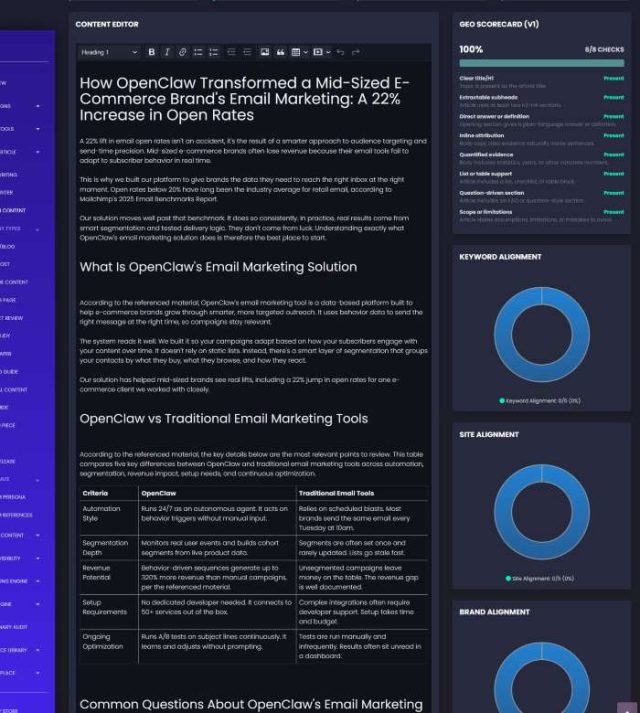
After review, generate the article as normal. A strong GEO article should feel more structured and more answer-focused than a standard post. In many cases, it should open faster, state definitions more clearly, and use more visible structure inside the body.
SEO GPT 2’s GEO Scorecard is especially useful after the first draft. It checks for core signals such as a clear title, extractable subheads, a direct answer or definition, inline attribution, quantified evidence, list or table support, a question-driven section, and scope or limitations.
That scorecard should not be treated like a bonus feature. It should be treated like a publishing gate. If a major GEO signal is missing, the article is not yet as strong as it could be.
What to expect from a good GEO article
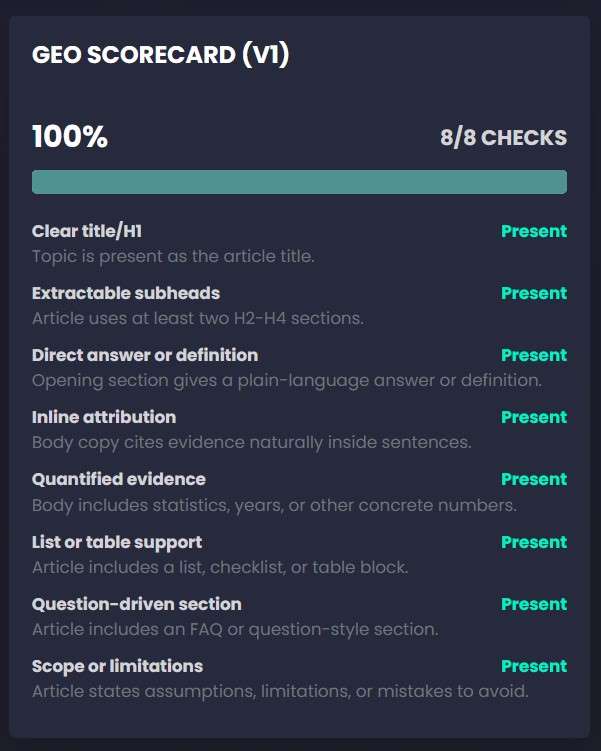
When the workflow is used well, the finished article should usually include:
- A clear title that states the topic plainly
- An opening that answers the main question quickly
- Subheads that work as standalone prompts or promises
- Sections built with Q and A, bullets, steps, or comparisons where useful
- Natural attribution and visible support in the body
- Facts, examples, numbers, or trade-offs when they fit
- A question-led section for common user concerns
- A scope, limitations, or mistakes section that adds trust
Example workflow: from idea to publish
Here is what the complete GEO process looks like inside a real content operation:
- Start with a business question, not just a keyword.
- Run GEO Topics in Topical Authority to generate sharper article directions.
- Expand the most promising idea until the angle and sections feel clear.
- Move the winning topic into SEO GPT 2 and select the GEO pathway.
- Add smart notes that define the audience, proof needs, and content boundaries.
- Review and improve the subheads before generation.
- Generate the draft, check the GEO Scorecard, and strengthen weak areas.
- Publish the article, then use the remaining topic map ideas to build the next pieces in the cluster.
Example: B2B SaaS version
This workflow is not limited to local SEO. Imagine a B2B SaaS company targeting operations leaders. Instead of starting with a generic phrase like AI automation software, a stronger GEO seed could be: How to Evaluate AI Workflow Automation Tools for Mid-Market Operations Teams.
That one topic can lead to a much stronger editorial cluster: comparison articles, implementation guides, cost and ROI content, common objections, and mistake-prevention content. In other words, GEO creates structure not just for one article, but for the entire content roadmap around the buying decision.
How beginners should use this workflow
Beginners do not need to overcomplicate GEO. Start with a clear, specific topic. Choose GEO Topics in Topical Authority. Pick the idea that feels easiest to answer with real clarity. Then use the GEO pathway in SEO GPT 2 and make sure every section title is specific.
If you are new, your first goal is not perfection. It is usefulness. A beginner-friendly GEO article that answers clearly, uses clean headings, and includes a few concrete examples will usually outperform a vague article that sounds polished but says little.
How advanced teams can get more leverage
Experienced content teams can use GEO more aggressively. One of the best approaches is to use Topical Authority for cluster design, then group GEO topics by decision stage: awareness, evaluation, comparison, implementation, and proof.
Another smart move is to create repeatable section patterns. For example, every comparison article can include a quick answer, a comparison snapshot, trade-offs, ideal use cases, common objections, and a final recommendation. Every how-to article can include a direct definition, a numbered framework, required inputs, common mistakes, and scope limits.
This kind of structured editorial system makes it easier to scale quality across multiple writers, verticals, or client accounts.
Common GEO mistakes to avoid
The first mistake is choosing a topic that is too broad. Broad topics create weak sections and generic openings.
The second mistake is writing clever subheads that do not say anything specific. If a section title cannot stand on its own, it is usually too vague.
The third mistake is skipping proof. GEO does not reward empty confidence. It rewards useful structure plus believable support.
The fourth mistake is ignoring limitations. A trustworthy article often becomes stronger when it explains trade-offs, edge cases, and when the advice may not apply.
The fifth mistake is treating GEO like keyword stuffing in a new costume. GEO works best when the language is plain, direct, and genuinely helpful.
A practical publishing checklist
Before publishing any GEO article, confirm the following:
- The title states the topic clearly
- The introduction answers the core question quickly
- Each subhead is descriptive and specific
- At least one section uses a reusable structure such as steps, bullets, FAQs, or comparisons
- Important claims are supported with evidence, examples, or clear reasoning
- The article includes a question-driven or objection-handling section
- There is a limitations, risks, or mistakes section when appropriate
- The piece feels easy to quote, summarize, and scan without losing meaning
Final takeaway
SEO Vendor’s improved GEO workflow gives content teams something much more valuable than a faster article generator. It gives them a smarter way to decide what to publish and how to shape it for the next generation of search.
Topical Authority helps users generate stronger questions and sharper editorial angles. SEO GPT 2 helps transform those ideas into structured, answer-friendly content with a built-in GEO pathway and scorecard. Used together, the tools support a full content strategy that is not only optimized for search rankings, but also optimized for AI understanding, reuse, and citation.
The bottom line is simple. If your team wants better performance in generative search, do not start with fluff. Start with better questions, better topic maps, better section design, and better proof. That is how GEO content becomes publishable, scalable, and worth citing.
More details in SEO Vendor’s help manuals: SEO GPT 2 GEO Article User Manual and Creating Article Topics with the GEO Option