
The rules of ranking have quietly changed. In traditional search, a strong backlink profile and well-optimized content could push any brand to the top of the SERP. In AI-powered search — ChatGPT, Perplexity, Google AI Mode, and similar platforms — the determining factor is something harder to game: trust.
Table of Contents
Understanding how AI agents evaluate brand credibility isn’t just useful for your agency’s strategy. It’s becoming the core competency that separates agencies that win client renewals in 2026 from those that lose them.
How AI Agents Actually Choose Which Brands to Recommend
When a user asks an AI assistant “What’s the best CRM for a 10-person sales team?” the AI doesn’t run a live search and rank pages by domain authority. It draws on its training data and, in some cases, retrieval-augmented generation (RAG) from live web results. In both cases, it is looking for signals of consensus and credibility.
A brand shows up in AI recommendations when:
- Multiple authoritative, independent sources mention it in relevant context
- It has consistent, factual brand information across the web
- Review platforms, industry publications, and expert content cite it positively and repeatedly
- Its own content is clear, accurate, and aligned with how third parties describe it
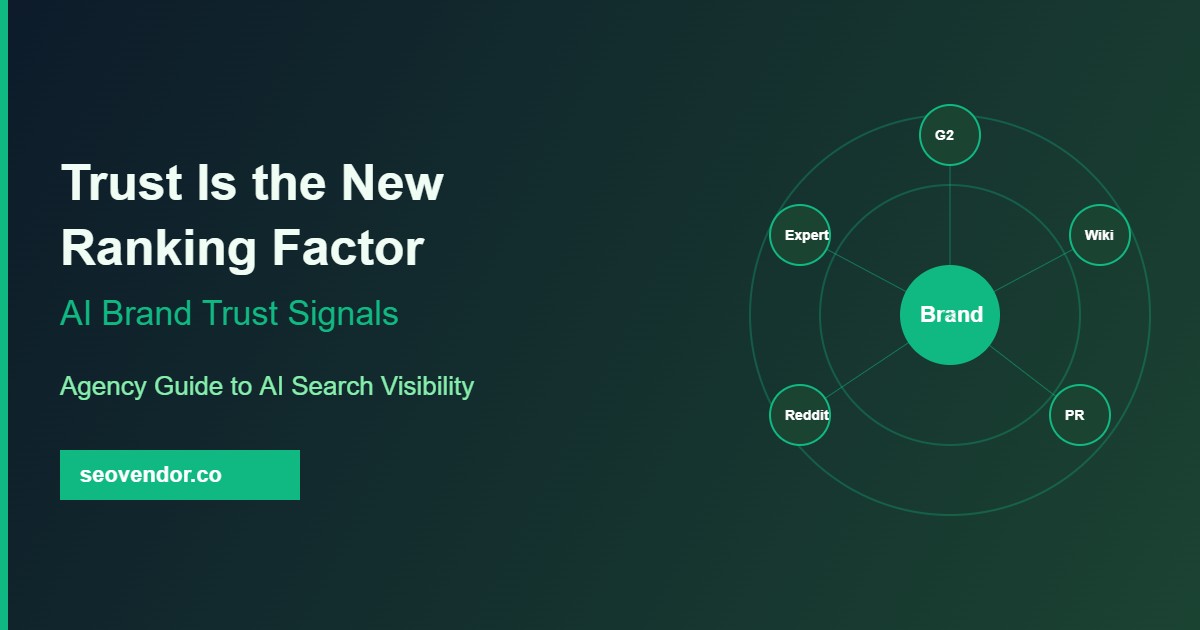
This is what researchers and practitioners are calling the “consensus layer” — the body of agreement across sources that tells an AI model a brand is real, credible, and relevant.
Why Backlinks Alone Won’t Get Your Clients Recommended
Traditional link building focused on quantity and authority of inbound links. AI agents don’t read the link graph — they read content. A client can have thousands of backlinks from high-DA sites and still be invisible in AI recommendations if the content mentioning their brand is:
- Inconsistent (different descriptions across sources)
- Transactional rather than editorial (press releases vs. genuine third-party coverage)
- Absent from the specific industry contexts where AI draws recommendations
Conversely, a newer brand with fewer traditional backlinks but strong editorial coverage in niche industry publications, consistent mentions in expert roundups, and positive user-generated content on Reddit and forums can dominate AI recommendations.
The 5 Trust Signals AI Models Evaluate
1. Mention Consistency Across Authoritative Sources
AI models weight sources differently. A mention in a TechCrunch article, a G2 review, a Reddit thread, and a specialist industry blog all carry different signals — but collectively, they build consensus. The more a brand is mentioned consistently (same name, same core positioning, same use case) across diverse, credible sources, the more trustworthy it appears to AI.
Agency action: Audit where your client is mentioned online and look for inconsistencies in how they’re described. Standardize the brand narrative across all touchpoints.
2. Review Platform Presence and Sentiment
Platforms like G2, Capterra, Trustpilot, and Google Business Profile are heavily indexed and cited by AI systems. A brand with hundreds of detailed, positive reviews — especially reviews that match the use cases users are asking about — will consistently appear in AI recommendations for those use cases.
Agency action: Run a review gap analysis. Compare your client’s review volume and quality against top competitors. Build a review acquisition strategy targeted at the specific use cases you want AI to associate the brand with.
3. Wikipedia and Knowledge Panel Accuracy
Large language models are trained on Wikipedia and structured data from Google’s Knowledge Graph. Brands with a Wikipedia presence or a well-populated Google Knowledge Panel have a significant AI visibility advantage. The information in these sources is treated as “ground truth” by many AI systems.
Agency action: Audit your client’s Google Knowledge Panel for accuracy and completeness. If the client qualifies for a Wikipedia article (notable brand, verified coverage), this should be a priority project.
4. Brand Entity Clarity
AI systems use entity recognition to understand what a brand does. If a brand’s web presence is ambiguous — unclear what industry it’s in, who it serves, what problems it solves — AI agents won’t confidently recommend it even if they “know” it exists.
Agency action: Review the client’s homepage, About page, and structured data (schema markup). The brand’s name, category, location, and primary offering should be unambiguous and consistent with how the brand appears across the web.
5. Expert and Editorial Citations
AI agents learn from the same expert content humans trust: major publications, industry analysts, podcast transcripts, webinar summaries, and long-form editorial. A brand cited by name in an expert’s framework, a methodology, or an industry report carries significantly more trust than a brand mentioned only in press releases.
Agency action: Map the key publications, podcasts, and thought leaders in your client’s industry. Build a strategy to earn genuine editorial mentions — through digital PR, expert contributions, data studies, and bylined content.
Practical Steps for Agencies: Building an AI Trust Audit
The agencies winning in AI search right now are those offering what we’re calling the AI Trust Audit — a structured review of a brand’s trust signal footprint across the sources AI systems care about. Here’s a simplified version you can deploy:
- Query the major AI platforms directly: Ask ChatGPT, Perplexity, and Google AI Mode questions your target customer would ask. Note which brands appear and which don’t. If your client doesn’t appear, that’s your baseline.
- Source attribution audit: Look at which sources AI cites when recommending competitors. Are those sources attainable for your client?
- NAP and entity consistency check: Verify name, address, phone number, and brand description consistency across all major directories, review sites, and social platforms.
- Review volume and quality assessment: Compare review counts and sentiment against top 3 competitors on G2, Trustpilot, and Google.
- Wikipedia and Knowledge Panel audit: Check existence, accuracy, and completeness.
- Editorial mention analysis: Use Ahrefs content explorer or BuzzSumo to count editorial mentions vs. press release mentions. You want editorial heavily outweighing press releases.
How White-Label SEO Resellers Can Package This
AI trust building is a new service category with high perceived value and repeatable deliverables. For white-label SEO resellers, it’s an opportunity to upsell existing clients and differentiate from competitors still only offering traditional link building and on-page audits.
Consider packaging AI trust services as a distinct offering: AI Visibility Audit, AI Brand Authority Building, or AI Search Readiness Assessment. These are services your clients don’t know they need yet — but will urgently want when they notice competitors appearing in ChatGPT and they don’t.
The Bottom Line: Trust Is the New Link
For two decades, the SEO industry’s north star was link authority. In the AI search era, trust is the equivalent signal — and it’s built through editorial consensus, consistent brand information, and genuine third-party credibility rather than link acquisition alone.
Agencies that understand this shift and build services around it will be indispensable to clients navigating a search landscape where AI intermediaries now sit between the user and the website. The agencies that don’t will find their traditional deliverables becoming increasingly irrelevant.
Key Takeaways for Agencies
- AI agents recommend brands based on trust signals across the web, not just traditional ranking factors
- The “consensus layer” — consistent brand mentions across authoritative, diverse sources — is the core AI visibility signal
- Review platforms, Wikipedia, Knowledge Panels, and editorial coverage are the highest-weight sources
- Offer an AI Trust Audit as a new service: query AI platforms, audit brand consistency, and identify mention gaps
- White-label resellers should package AI visibility services as a distinct, high-value offering