
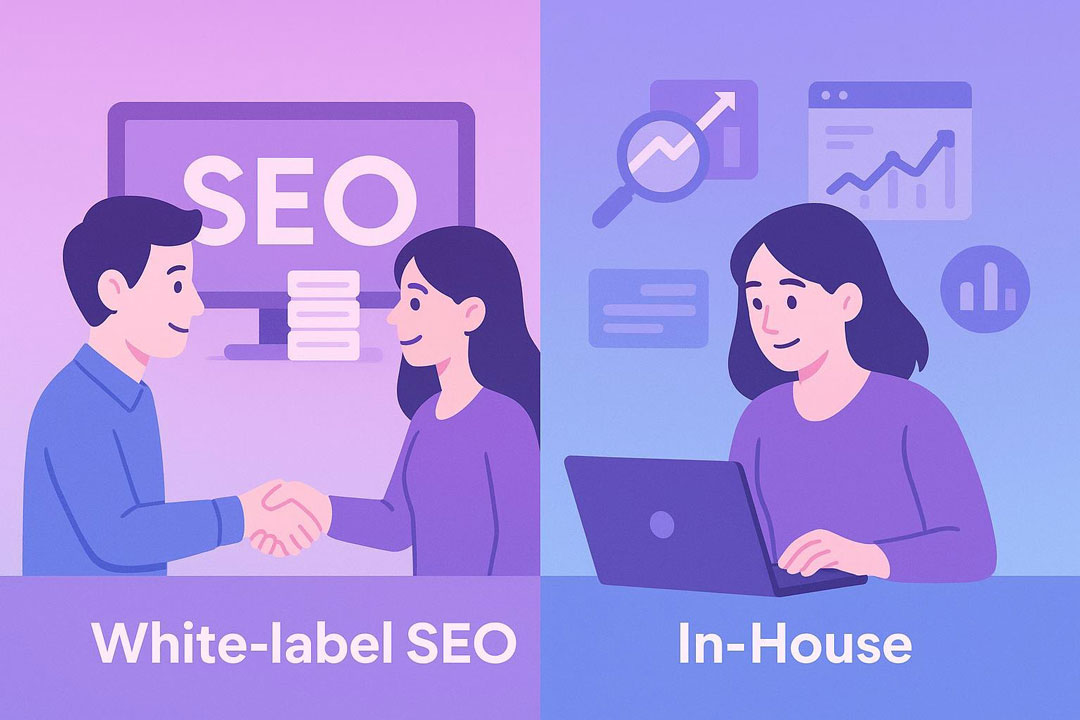
Agencies evaluating enterprise seo solutions for businesses often compare white label SEO against building an in-house team. Each option introduces real trade-offs across cost structure, control, scalability, depth of expertise, and operational complexity. The right decision depends on how your agency plans to grow, how many client verticals you support, and how much operational overhead you are prepared to manage.
Table of Contents
As client expectations rise and SEO programs become more technical, agencies must balance customization with efficiency. Internal teams can offer tighter brand control, while white label partners can absorb volume and complexity without adding headcount. Understanding these dynamics early helps agencies avoid stalled growth, margin compression, or quality drift as demand increases. A practical comparison starts with cost.
Evaluate Cost Implications for SEO Services
Cost structure directly affects agency profitability. White label SEO typically operates on predictable monthly pricing, allowing agencies to forecast margins with greater confidence. In contrast, in-house SEO teams require salaries, benefits, onboarding, and long-term retention investment.
In addition to payroll, internal teams rely on paid SEO platforms. Industry-standard tools such as SEMrush or Ahrefs often cost between $200 and $500 per month per seat, according to Search Engine Journal. As teams grow, tooling costs scale quickly. Training expenses add further overhead, particularly as the search evolves and staff require ongoing upskilling.
White label SEO providers typically bundle tooling, training, and process optimization into their service fees. This structure reduces upfront investment and shifts cost risk away from the agency. Internal hires also require ramp-up time. Many agencies report a three- to six-month window before new SEO staff operate independently, which delays revenue realization.
For smaller agencies or those managing volatile workloads, fixed white label pricing can stabilize cash flow. Larger agencies with consistent volume may justify in-house investment, but only if utilization remains high. These trade-offs explain why many agencies adopt hybrid models using enterprise seo services to offset internal cost pressure while maintaining margin discipline.
Assess Scalability and Flexibility Needs
Agency growth rarely follows a straight line. New client wins, seasonal spikes, or vertical expansion can dramatically increase workload with little warning. Scalability becomes a deciding factor when comparing white label SEO and in-house teams.
White label SEO partners are designed to absorb workload fluctuations without degrading delivery timelines. Capacity can expand or contract as client demand changes, allowing agencies to scale without long hiring cycles or burnout risk.
Adaptability to Changing Workloads: White label providers can increase campaign output in real time as client volume grows, reducing delivery bottlenecks.
Specialists on Demand: Advanced technical SEO, large-scale migrations, or link strategy often require niche expertise that in-house teams may not have immediately available.
Reduced Recruitment Stress: White label scaling eliminates months of recruiting, onboarding, and training required to expand internal teams.
Fast Client Onboarding: Many white label programs enable new campaigns to launch within days rather than weeks, supporting faster revenue recognition.
Flexibility for Custom Needs: Agencies can adjust service depth monthly, supporting startups, regional brands, or global enterprises without restructuring internal resources.
Scalability favors systems over individuals. Agencies prioritizing growth velocity often lean toward white label partnerships to maintain delivery consistency under pressure.
Consider Control Over SEO Strategies
Control over execution and decision-making is a core consideration. In-house teams offer direct oversight across keyword strategy, technical changes, and content priorities. This proximity can accelerate testing and iteration.
With white label SEO, agencies must balance delegation with governance. Clear processes and reporting structures are essential to avoid visibility gaps.
Oversight of Tactics: In-house teams allow granular monitoring of on-page, off-page, and local SEO execution.
Speed of Changes: Internal teams can deploy updates quickly, particularly for time-sensitive initiatives such as franchise rollouts or ecommerce optimizations.
Depth of Customization: Direct access to staff supports fine-grained adjustments, including metadata tuning or internal linking refinements.
Risk of Lost Control: Outsourcing without structured communication can create delays or misalignment if expectations are not clearly documented.
Specialist Knowledge Spread: White label partners like SEO Vendor distribute specialized expertise across focused teams, whereas internal staff often juggle multiple disciplines.
Agencies that prioritize precision and rapid experimentation may favor in-house execution, while those focused on scale rely on governance frameworks to maintain control over outsourced work.
Analyze Access to Specialized Expertise
Depth of expertise often differentiates high-performing SEO programs from average ones. White label SEO provides access to multidisciplinary specialists without requiring permanent hires.
Broader Range of Skills: White label teams typically include technical SEO specialists, content strategists, and data analysts working within defined processes and supported by AI SEO tools.
Up-to-Date Industry Knowledge: Providers invest in ongoing training to stay aligned with algorithm updates, technical standards, and search behavior changes.
Increased Capacity for Complex Projects: Large migrations, multi-domain strategies, and international SEO initiatives often exceed the practical capacity of small internal teams.
Internal teams can develop strong institutional knowledge over time, but maintaining broad expertise across all SEO disciplines requires sustained investment. White label partnerships allow agencies to deploy advanced capabilities selectively, aligning expertise with demand.
Examine Integration with Existing Teams
Operational fit matters as much as expertise. Agencies must assess how white label SEO integrates with internal workflows, project management systems, and client communication models.
Collaboration with Existing Workflow: Established white label providers integrate with common PM tools and reporting platforms, minimizing disruption.
Scaling Behind-the-Scenes Operations: Outreach, digital PR, and technical audits often require infrastructure that internal teams struggle to maintain consistently.
Expanding Expertise Without Hiring: White label partnerships provide access to specialized functions without internal training overhead.
Smooth integration depends on documentation, defined ownership, and shared performance benchmarks. When alignment is clear, white label SEO can function as an extension of the internal team rather than an external vendor.
Determine Time and Resource Commitments
Time allocation is frequently underestimated when agencies evaluate SEO delivery models.
Initial Onboarding Timeline: White label SEO programs often launch within days, while in-house hiring and onboarding can take months.
Ongoing Resource Management: Internal teams require ongoing oversight, training, and capacity planning. Staff turnover can disrupt delivery continuity.
Specialist Access for Client Demands: Niche skills such as app store optimization or zero-click SERP strategy may not exist internally, delaying execution.
White label SEO shifts time-intensive operational management away from agency leadership, allowing focus on client relationships, strategy, and growth.
Review Quality Control and Customization
Quality assurance processes differ significantly between models. As agencies scale, the way quality is monitored, reviewed, and corrected becomes a direct driver of client retention and margin stability. Small inconsistencies that feel manageable at low volume can quickly multiply across dozens or hundreds of campaigns, making QA structure a strategic decision rather than an operational detail.
Quality Assurance: White label teams rely on standardized QA workflows, while in-house teams benefit from direct oversight and immediate feedback loops. Standardized checklists help maintain baseline quality, but rapid iteration is often easier when teams sit closer to decision-makers.
Customization and Brand Alignment: Internal teams naturally align with brand voice, while white label providers depend on detailed briefs and review cycles. Clear documentation, examples, and approval steps are critical to closing this gap and maintaining tone consistency.
Consistency and Control: White label systems enforce consistency at scale, whereas in-house teams may struggle to maintain quality during rapid expansion. As workload increases, repeatable QA frameworks reduce variance and protect delivery standards.
Agencies must decide whether consistency or bespoke execution is the priority and structure QA processes accordingly.
Understand Communication and Collaboration Dynamics
Communication frameworks determine execution efficiency. When SEO delivery spans account managers, strategists, analysts, and external partners, clarity becomes a performance multiplier. Without defined communication rules, even strong strategies break down through delays, misalignment, or duplicated effort. Agencies that scale successfully treat communication as part of the SEO system itself, not an afterthought.
Shared Language and Process: Alignment across account managers and SEO teams ensures consistent client delivery. Using the same terminology, success metrics, and workflow stages reduces interpretation gaps and keeps reporting clear for clients.
Point of Contact Structure: Defined ownership reduces friction and accelerates issue resolution. When responsibility is clear, decisions move faster and accountability stays intact.
Regular Status Meetings: Routine check-ins prevent minor issues from escalating. Short, structured updates help surface blockers early and keep timelines realistic.
Documentation and Clarity: Written scopes and timelines minimize misunderstandings. Clear documentation protects both delivery quality and client expectations as campaigns evolve.
Escalation Protocols: Clear escalation paths ensure urgent issues receive timely attention. This prevents bottlenecks when technical, approval, or priority conflicts arise.
White label SEO succeeds when communication expectations are explicit, repeatable, and enforced across every campaign.
Evaluate Long-Term Sustainability and Growth
Long-term growth requires systems that scale without degrading performance.
Scalability for Growth: White label SEO supports expansion without proportional increases in overhead.
Retention of Business Knowledge: In-house teams preserve institutional knowledge but may constrain growth velocity.
Cost Predictability over Time: Outsourced models offer clearer cost forecasting, supporting financial planning.
Agencies increasingly adopt blended models, combining internal strategy with white label execution to balance control and scalability.
Choosing between white label SEO and an in-house team depends on your agency’s growth strategy, financial tolerance, and operational maturity. White label partners provide scalable systems, specialized expertise, and predictable costs. In-house teams offer tighter control and deeper brand alignment, but demand sustained investment.
SEO Vendor delivers structured workflows, AI-supported execution, and client-ready SEO reports designed for agencies scaling enterprise programs. By aligning delivery models with business goals, agencies can expand capacity, protect margins, and maintain consistent results across client portfolios.