
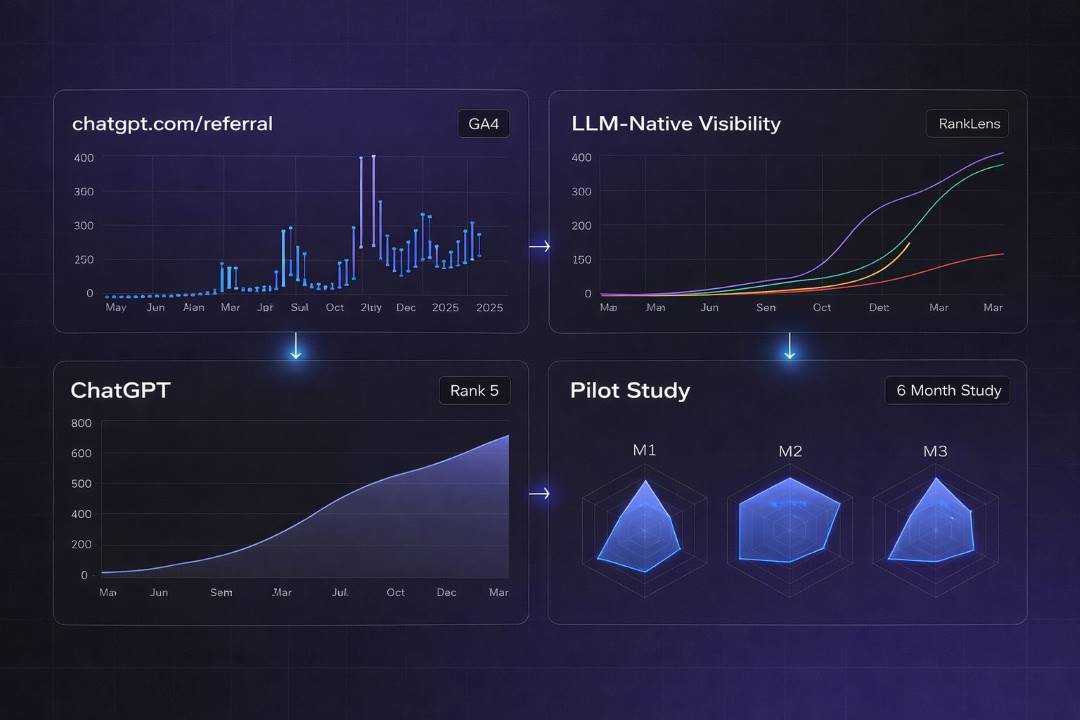
At SEO Vendor we explored this idea in two foundational pieces:
Table of Contents
- “Are SEO and GEO the Same or Just Roommates Sharing a Kitchen?” (October 2025)
- “A Systems View of GEO: What Metrics Actually Control Visibility?” (March 2026)
Our position has remained consistent: there is heavy tactical overlap with strong SEO foundations (E-E-A-T, clarity, topical authority, helpfulness), but the disciplines are not identical today. While most AI platforms still rely on RAG grounding in traditional search indexes, the full probability-engineering pipeline introduces new metrics and thinking that classic ranking-focused SEO did not emphasize.
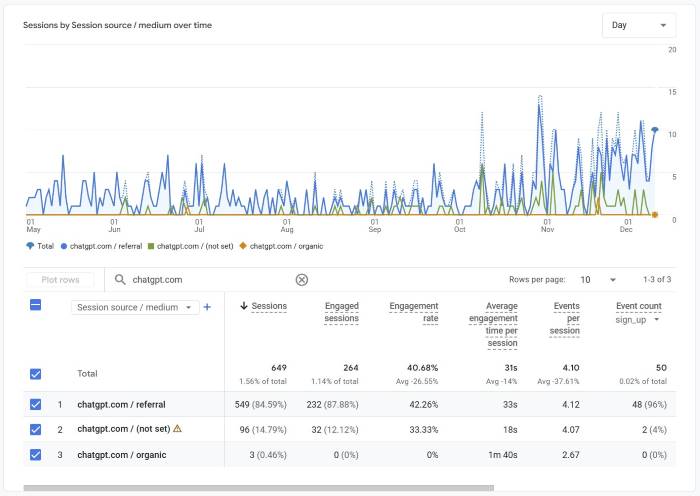
Case Study 1: 50 Signups from Direct ChatGPT Referrals (Business Impact Without Organic Traffic)
Result:
- 549 sessions from chatgpt.com/referral
- 50 total event signups
- 42.26% engagement rate
- Almost zero Google organic traffic
This outcome came from the “Citation” and “Answer Dominance” modules — not from traditional SERP clicks.
Case Study 2: Short-Term LLM-Native Visibility Surge (No RAG Required)
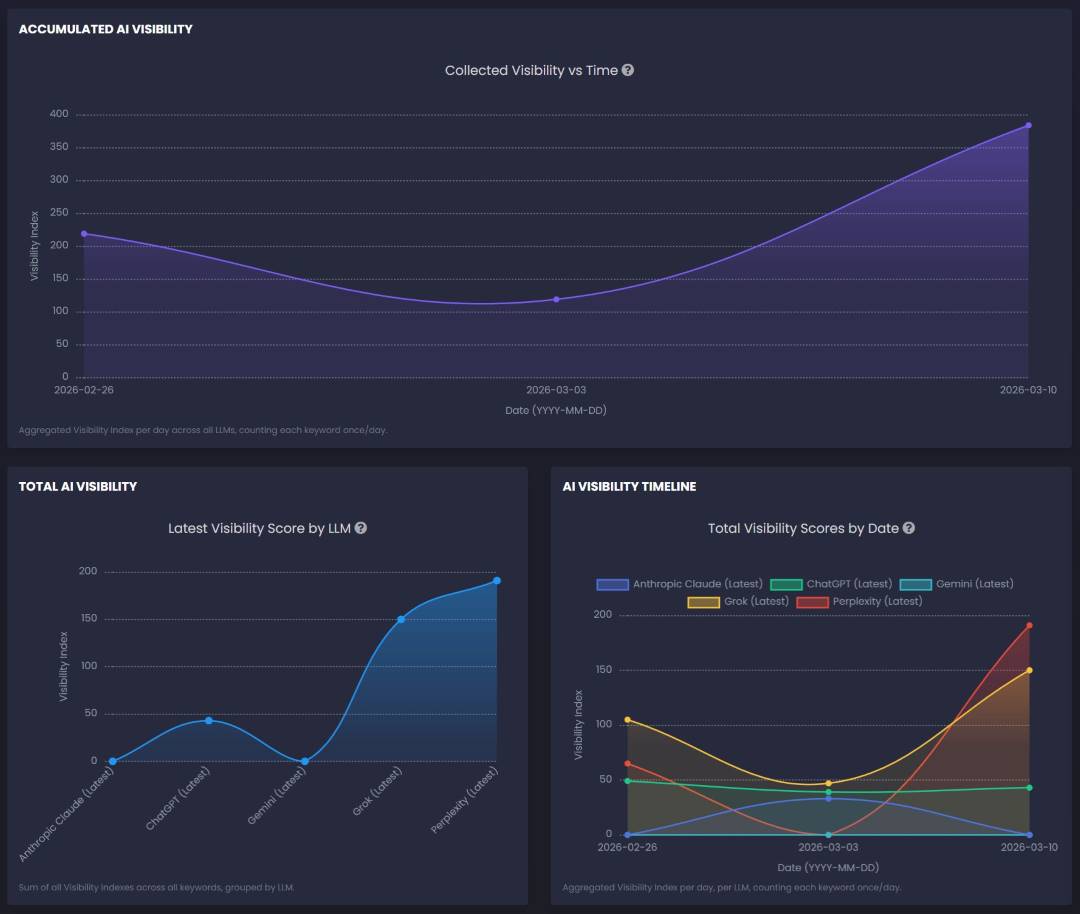
Focusing on candidate selection and summarization fidelity (quotability enhancements, freshness governance, off-site corroboration), the visibility index climbed from a February low to ~380 by March 10. Because the measurement was purely LLM-native, this growth was independent of Google or Bing rankings.
Case Study 3: Four-Month Sustained Visibility Growth Inside ChatGPT (Resilience Through Volatility)
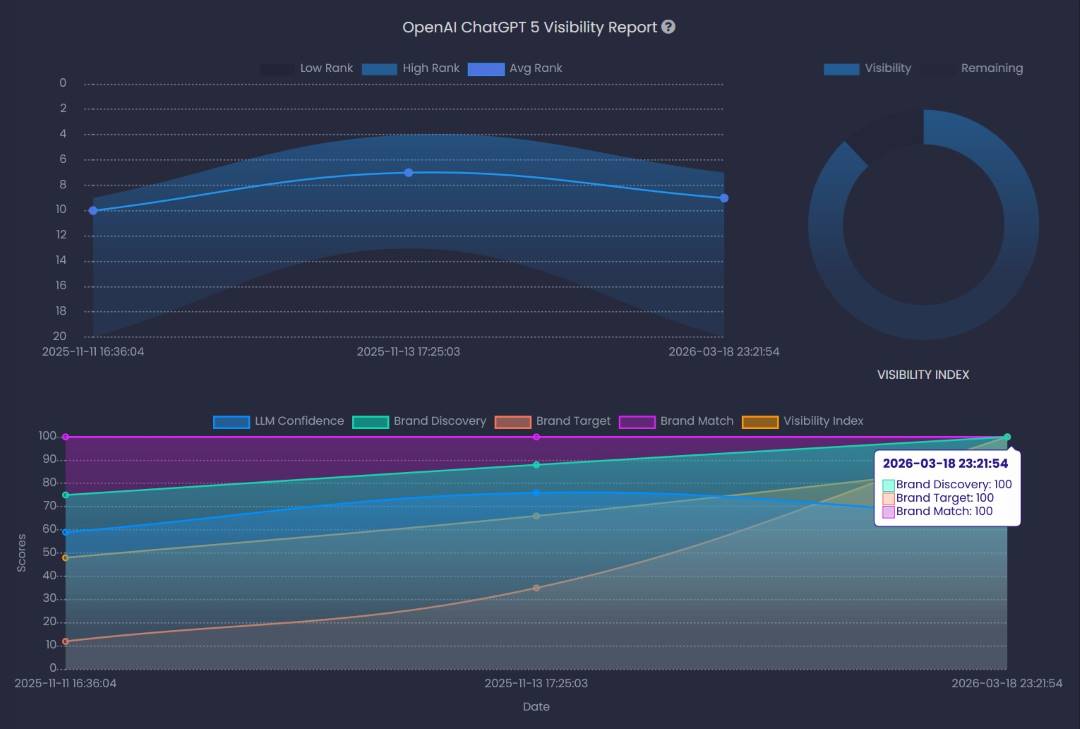
Case Study 4: 6-Month AI Visibility Pilot — Discovery to Full Confidence Growth
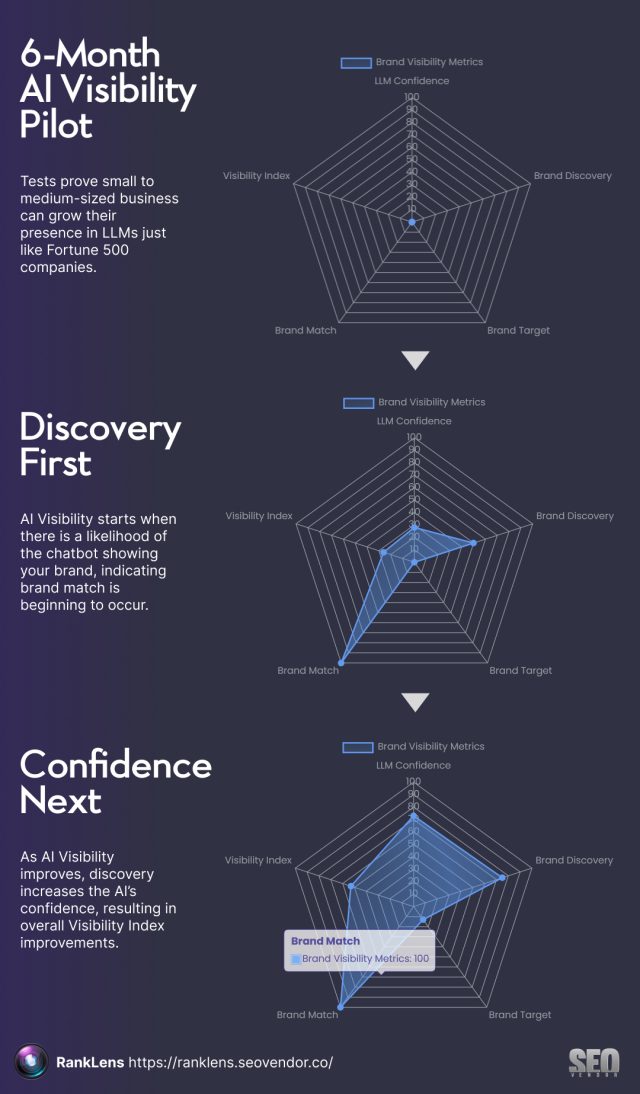
This pilot tested the full pipeline on a small-to-medium business and produced the clearest visual proof of the sequence we describe in the systems-view framework.
- Early phase: Brand Discovery rises first (likelihood of the chatbot even mentioning the brand).
- Middle phase: LLM Confidence grows, driving overall Visibility Index upward.
- End result: Every major metric (including Brand Match) reaches the maximum score of 100.
The outcome shows that even smaller sites can achieve Fortune-500-level presence inside LLMs when the probability chain is deliberately engineered — without relying on massive organic traffic spikes.What These Examples Show About GEO and SEO TodayThese four projects highlight why we still view the two disciplines as roommates sharing a kitchen rather than the same person:
|
Aspect
|
Traditional SEO Lens
|
GEO Systems View
|
Outcome in These Cases
|
|---|---|---|---|
|
Primary Success Metric
|
Rankings + clicks
|
Citation rate + direct conversions
|
50 signups + 100-point index gains
|
|
Optimization Focus
|
SERP signals
|
Full 5-module probability pipeline
|
Extractability + governance + quotability
|
|
Traffic/Visibility Source
|
Mostly organic search
|
Direct AI referrals + LLM-native indexes
|
Independent of organic rankings
|
|
Resilience in 2026
|
Vulnerable to scaled-content filters
|
Stable when full pipeline is engineered
|
No crash through volatility
|
|
Scalability
|
Requires strong backlink/traffic base
|
Works for small-to-medium businesses too
|
6-month pilot reaches 100 across metrics
|
The execution overlaps significantly, and we fully acknowledge that SEO authority signals still exert profound influence on most RAG-based AI results. What the systems view adds is a new mental model: AI engines excerpt, compress, and prefer content that is explicitly safe-to-cite and easily extractable — nuances that pure ranking optimization sometimes overlooks.
We are not arguing for complete separation (We’re SEO Vendor after all 🙂 ). As long as traditional rankings-based search and AI-generated answers coexist, the two playbooks differ in emphasis. When (or if) AI becomes the sole primary interface, the distinction will naturally disappear.
Practical Takeaways You Can Use Tomorrow
- Map every piece of content to the 5-module pipeline.
- Score for extractability and quotability (lists, tables, fact boxes).
- Build dedicated governance pages for citation safety.
- Track LLM-native metrics alongside traditional rankings — look specifically for the Discovery → Confidence → Visibility sequence.
- Avoid mass-content shortcuts — the volatility pattern is real and tied to scaled spam, not thoughtful GEO engineering.
We’ll continue publishing longer-term studies as more data rolls in. In the meantime, we’d love to hear what you’re seeing in your own projects. Drop a comment below or reach out if you’d like a quick systems-view audit on your site (we use RankLens internally for exactly these measurements).