
Keyword research didn’t stop working. But it stopped being enough.
Table of Contents
In traditional SEO, a keyword is the unit of planning: find phrases → write pages → rank.
In AI search (ChatGPT, Perplexity, Gemini, Claude), the unit is different. These systems don’t “think” in keywords the way Google’s keyword matching does. They reason through entities (people, brands, products, categories, concepts) and the relationships between them.
That shift changes the strategy:
Old workflow: Pick keywords → write pages
New workflow: Pick entities → build authority around the right concepts
That’s exactly what our Entity Research App was built for. It’s part of our GEO campaigns—and it’s also available inside our platform through Insight Igniter AI (Free + PRO).
What is the Entity Research App?
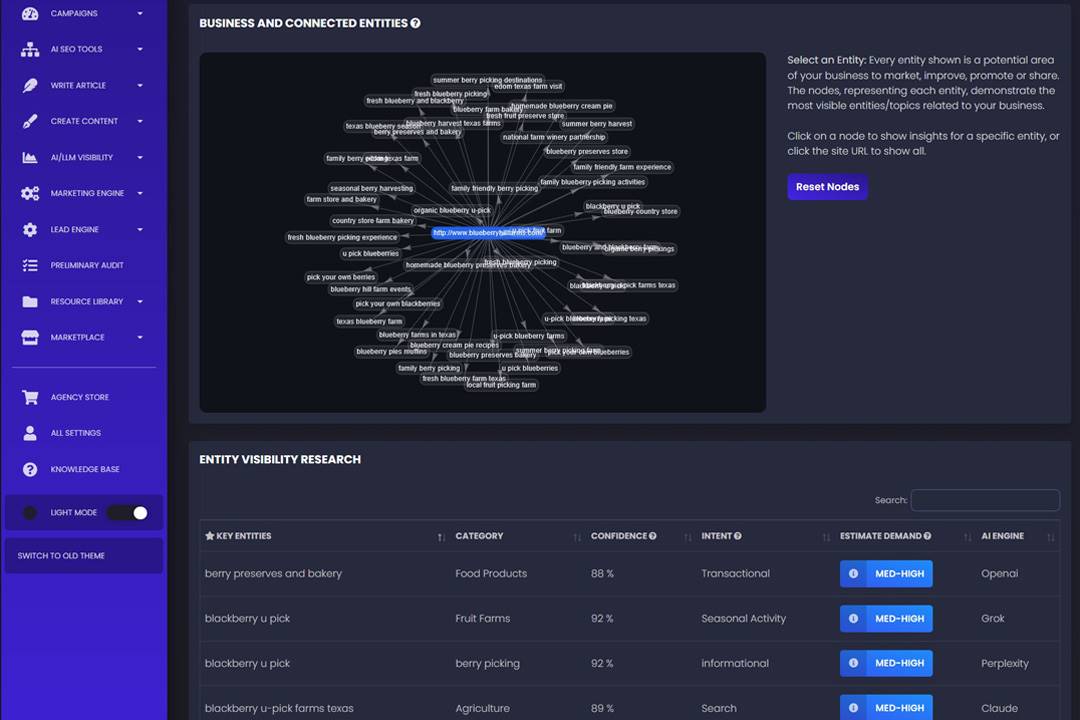
The Entity Research App is a discovery and planning tool that maps the entities AI engines associate with your business—then organizes them into a client-friendly list you can select from and build strategy around.
Think of it as the bridge between:
- “What we sell” (your brand, products, services)
and - “How AI describes you” (the concepts it connects you to)
It produces a structured output that helps you decide what to reinforce, what to correct, and what to expand—before you invest in content, citations, or campaigns.
Why entity research matters in GEO
In GEO (Generative Engine Optimization), you’re not only trying to rank on a blue link. You’re trying to become a repeatable recommendation.
That requires something keyword tools don’t measure well:
Consensus across models
If ChatGPT links your brand to an entity… but Gemini doesn’t… and Claude is inconsistent…
you don’t have authority—you have noise.
Entity Research helps you move from “random mentions” to reliable association, because it forces clarity around:
- What AI engines believe your business is
- What entities they connect you to
- Which entities are weakly associated (gaps)
- Which entities are strongly associated (owned territory)
What the tool outputs
The Entity Research App is built to produce a practical starting point:
1) Entity Map (50+ entities)
A structured set of entities AI associates with your business. These aren’t just random keyword ideas—they’re the “topic neighborhood” AI places you in.
2) Confidence
A signal of how strongly the model links your brand to each entity. (High confidence entities tend to be easier to reinforce; low confidence but high value entities reveal strategic gaps.)
3) Demand signal
A signal for which entities show up most often in AI conversations and discovery paths. This helps prioritize what matters—not just what exists.
What else can entity-based analysis do?
Entity research isn’t just “keyword research, but modern.” It unlocks a set of workflows that are hard to do with keyword tools alone.
1) Find the needle in the haystack
Most businesses have too many possible content angles. Entity Research helps you identify the few entities that actually change outcomes:
- Entities that reliably trigger AI recommendation patterns
- Entities where competitors appear “by default”
- Entities that represent high-intent categories (money topics)
Instead of writing 50 pieces of content because “the keyword list is long,” you build around the handful of entities that shift perception.
2) Diagnose “why am I not showing up?”
If a brand isn’t being recommended by AI engines, the problem is usually one of these:
- The model doesn’t understand what the business is
- The model associates the business to the wrong category
- The brand/entity relationship is too weak or inconsistent
- Competitors have stronger entity ties
Entity mapping surfaces those causes quickly.
3) Prevent content waste
Without entity alignment, content can be technically “optimized” but strategically scattered. Entity Research helps you avoid publishing pages that don’t reinforce your intended positioning.
4) Build an entity-first content roadmap
Instead of a list of disconnected keyword targets, you get:
- Entity clusters
- Supporting subtopics
- Coverage gaps
- A natural internal linking architecture
This is the foundation of semantic authority building.
5) Competitive “default wins”
Some competitors show up in AI answers not because they ranked one page—but because the model has learned a stronger association between them and a core entity.
Entity Research reveals those “default wins” so you can plan to counter-position or build stronger associations.
How Entity Research works (high-level)
The app runs in a repeatable process:
Step 1: Input your business identity
You provide:
- Website URL (homepage by default)
- Brand name
- Language
- Insight mode (Deep Learning for best results)
Step 2: Generate entity discovery
The system analyzes the brand’s topic neighborhood and outputs an entity list with metadata like:
- Category
- Confidence
- Intent
- Demand
Step 3: Organize results into research groups
Most runs produce ~50 entities. When clients can choose more entities, you create additional groups:
- 5 selections → ~50 options (1 group)
- 10 selections → ~100 options (2 groups)
Only in special cases do you need more groups.
Step 4: Select entities for the campaign
The client (or your strategist) selects the final 5–10 entities that will guide:
- GEO prompts / probing strategies
- content planning and internal linking
- structured data / semantic reinforcement
- citation and mention strategies (where applicable)
Advanced grouping: when to go beyond the homepage
If the entity list doesn’t fully capture the business, you can create “advanced groups” by using a high-value internal URL instead of the homepage, such as:
- Key product pages
- Key service pages
- About page (if it strongly communicates positioning)
- Truly worthwhile blog articles (only if representative)
This helps the tool explore specific sub-areas of the business and can produce a cleaner entity set.
Entity Research App vs. Insight Igniter AI (Free + PRO)
Entity Research App is the campaign workflow we use for GEO: structured, group-based, client-friendly selection.
Insight Igniter AI is our platform version of the same capability: (link here)
- Free: great for exploration and baseline discovery
- PRO: deeper discovery, consensus across 5 AI models, more robust results, and improved consistency
If you’re on our platform, you can access entity discovery even if you’re not currently running a full GEO campaign. That means:
- DIY users can map their brand’s entity neighborhood
- agencies can create entity-based strategy deliverables
- teams can build semantic roadmaps before publishing content
How to choose the right entities (the framework)
When choosing 5–10 entities, the biggest mistake is picking duplicates of the same idea. A good selection is balanced:
A strong 5-entity selection typically includes:
- 3 core offers (what you sell)
- 1 high-intent buyer entity (purchase/decision intent)
- 1 authority/adjacent entity (supporting theme)
A strong 10-entity selection typically includes:
- 5 core offers
- 3 high-intent buyer entities
- 2 adjacent authority entities
The goal isn’t “more entities.”
It’s the right set of entities that create repeatable recognition across AI engines.
Who should use this tool?
Entity Research is most valuable for:
- Brands not getting recommended in AI engines
- Businesses in crowded categories where competitors “win by default”
- Teams publishing lots of content but not building clear authority
- Agencies who need a modern alternative to keyword spreadsheets
- GEO-focused campaigns where entity association is the primary lever
What success looks like
A successful entity research outcome isn’t “a big list.”
It’s:
- a clean, prioritized set of entities
- obvious gaps and opportunities
- clear direction for content + semantic reinforcement
- increased consistency in how AI engines describe and recommend the brand